How AI Startups Hire Differently From Big Tech in 2026
Big Tech narrows job skills while AI startups demand generalists who ship fast.
Advertisement
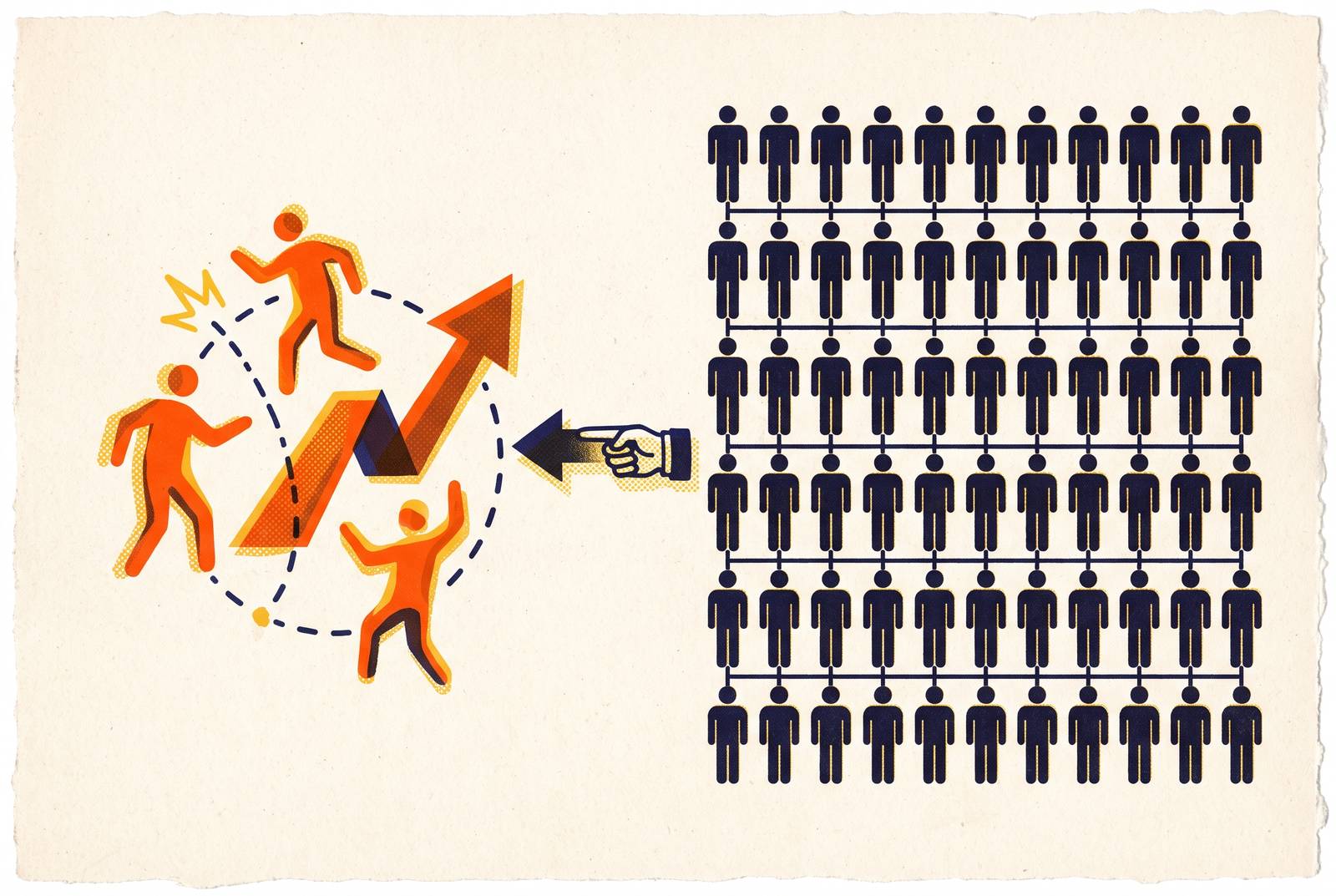
Tech hiring broke into two separate systems in 2026, and the split traces back to one fact: a single senior engineer with AI tooling can now do what used to take a small team. Big Tech and AI startups both ran into that fact at the same time, and both rebuilt their hiring around it, but they went in opposite directions. Big Tech responded by pruning its ranks and narrowing its focus to specific, testable skills. Early-stage AI startups responded by hiring fewer people but demanding more from each one, betting that a small founding team armed with AI tools can build what once needed a whole department. That's why startup headcount growth has slowed even as ambition hasn't. What looks like one tight labor market from the outside is really two separate philosophies about what engineering labor is even for: one side is specializing and cutting, the other is building from a baseline where each hire has to carry far more weight than before.
What Big Tech actually looks for and signals in its hiring process
Big Tech in 2026 runs on a philosophy of proven, narrow skill. The hiring loop is still structured and multi-round, built to test specific abilities that can be scored and compared across thousands of candidates. What's changed is the content of those rounds, updated to match how senior engineers actually build software now. System design interviews, for instance, have split into three separate tracks: the traditional system design question, the ML system design question, and the generative AI system design question. That last category barely existed a couple of years ago. It went from a niche add-on to a standard part of the loop in under 18 months.
What this process tells a candidate is plain once you see the shape of it. Big Tech rewards people who can show deep, provable mastery in one lane, and who can operate inside a large, structured organization without losing speed. It isn't rewarding breadth across the whole stack, and it isn't rewarding people who want to own a product end to end. Big Tech still offers things a startup can't: mentorship from engineers who've solved these problems at a scale few companies ever reach, and a quality bar that stays consistent across thousands of engineers and years of turnover. The hiring loop exists to protect that bar, and it tests for exactly the kind of specialist who can hold it up.
How AI startups screen for a different thing entirely
AI startups have mostly thrown out the FAANG-style loop on purpose, not by accident. Recruiting guidance aimed at founders warns them directly that the algorithmic-puzzle format selects for the wrong person at the startup stage, someone who's good at interviews rather than someone who can build.
The typical startup hiring process runs through three or four stages: a founder screen, a hands-on build session (sometimes a short paid contract project), and one or two deep conversations covering both technical depth and culture fit. The whole thing usually wraps in one to two weeks. Startups move that fast because they have no choice. A six-week hiring process is a luxury only a company with a deep bench and steady revenue can afford, and most early-stage AI companies have neither.
What a startup is really testing becomes clear in that build session. Can this person own an outcome across the full stack? Can they make a real decision with incomplete information and ship something in a day, not a sprint? The hands-on exercise isn't a proxy for that skill, it's a direct test of it: the candidate either produces something working under real constraints, or they don't.
One wrinkle complicates the idea that startup hiring is purely meritocratic. Startups still lean on pedigree as a filter, often because they don't have the time or staff to evaluate every applicant on substance alone. That tension doesn't change the core contrast: the build session, not the resume, decides who gets the offer.
The single most expensive mistake in AI hiring right now is bringing on the wrong type of engineer for the problem at hand. An AI engineer, an ML engineer, and a research scientist are not interchangeable people doing slightly different flavors of the same job. Each one has a different center of gravity, and a startup that confuses them can lose months chasing the wrong kind of progress.
An AI engineer takes an existing model and turns it into something a product can depend on. A company needs one of these when customers love the demo but can't rely on it in daily use. An ML engineer takes a system that technically works and makes it hold up under real traffic, real data, and real failure modes. A company needs one of these when the model performs fine in a notebook but breaks the moment it meets production. A research scientist or research engineer creates or validates something genuinely new, a method that doesn't exist yet. A company should only hire for that role when it truly cannot win without a technical breakthrough nobody has made. Most Series A and Series B AI startups need a research engineer, someone who can push the edges of what's known while still shipping, not a pure research scientist. The pure research scientist hire makes sense mainly at foundation model companies, where producing new research is the actual product, not a means to one.
Job titles don't reliably tell you which of these three a role actually is. "ML Engineer" and "AI Engineer" show up constantly as interchangeable labels on job postings, and what the title means in practice depends on the day-to-day responsibilities listed underneath it. That means an engineer evaluating an opportunity has to read the actual scope of the job, not the label on it, to understand which of the three roles they're really being assessed for. The interview itself should match that scope: an AI engineer candidate should get a realistic product failure to work through, an ML engineer candidate should get a production system and face questions on data pipelines, deployment, observability, and cost, and a research scientist candidate should get an open technical question and get judged on their experimental rigor and on what evidence would actually change their mind.
Big Tech solves this ambiguity structurally, through its level system. An L5 ML Engineer at a company with that framework has a defined scope attached to the title itself, so two people with the same title are doing recognizably similar work. Startups don't have that scaffolding, so the responsibility shifts to the candidate. Before accepting an offer, an engineer needs to ask directly what the role actually covers day to day, because no title or level is going to answer that question for them.
The Compensation Gap Between Big Tech and AI Startups
The old startup pitch, lower cash now in exchange for a lottery ticket in equity, doesn't fully describe how AI startups pay in 2026. The gap between Big Tech and startup compensation still exists, but it's narrower than it used to be, and how much it matters depends heavily on which role and which level you're talking about.
At senior-plus levels, roughly L6 and above in Big Tech terms, late-stage private AI companies can match or beat FAANG total compensation. The gap stays wide at junior and mid-level roles, where Big Tech still offers substantially more in guaranteed pay, mostly through RSUs stacked on top of base salary. A startup at Series A simply doesn't have a comparable stock-grant machine to offer a mid-level engineer, so the dollar figures at that tier remain lopsided in Big Tech's favor.
The part engineers get wrong most often is the equity itself. A typical small founding stake at a Series A company carries a real chance of paying out well, and it also carries a real chance of being worth close to nothing. Later funding rounds dilute that stake, sometimes by a lot, and dilution is the mechanism that quietly erodes an early offer's headline value over the following few years. Dan Luu's widely cited analysis of equity outcomes lays out just how uneven the payoff distribution actually is. None of this means startup comp is a bad deal. It means the comparison isn't really cash versus cash, it's guaranteed money against a wide range of possible outcomes.
What startups keep as a recruiting tool that Big Tech structurally can't match is influence over the actual shape of the product. An engineer joining early gets to help decide the architecture and the direction of the thing before any of it hardens into company policy. Samir Dutta of Farsight, quoted in an industry report from Dice, points to exactly this kind of intellectual ownership and mission stakes as the part of the startup offer that a company the size of Big Tech genuinely cannot reproduce, no matter how much it pays.
The acqui-hire risk that Big Tech's compensation advantage conceals
A newer pattern complicates the equity side of that pitch even further. Industry watchers have started calling it the "reverse acqui-hire" or the "quasi-merger": a Big Tech company hires away a startup's founder and its best engineers without ever formally acquiring the company itself. Because no acquisition happens on paper, the deal skips antitrust review entirely, and the employees left behind are holding equity in a company that's just lost its core team and, often, much of its reason to exist.
Google's January 2026 deal with the voice AI startup Hume AI shows the shape of this pattern. CEO Alan Cowen moved over to Google DeepMind as part of a licensing arrangement, taking several of the company's top engineers with him. Nobody bought Hume AI. Google just hired its leadership and licensed its technology, and whatever remained of Hume AI's cap table held equity in a company that had just lost the people who built it.
This risk clusters at a specific point in a company's life: Series A and Series B, where a startup has raised enough money to catch Big Tech's attention but hasn't generated enough revenue to stand on its own without its best people. An engineer trying to judge whether a given startup is exposed to this risk should look first at revenue, not funding. A company with real, recurring revenue has options and leverage; a company burning cash with no clear business model is the one most likely to get picked apart this way. One concrete warning sign is a startup that quietly stops hiring around the same time a Big Tech "partner" starts ramping up its own AI headcount. That same willingness to accept risk in exchange for equity and ownership also shapes how each system treats where and how people work.
How Remote Work Policies Differ Across the Two Systems
Remote work doesn't split cleanly along the Big Tech versus startup line the way the marketing from either side might suggest. What actually predicts whether a role is remote, hybrid, or fully on-site is company stage and role type, far more than which category the company falls into.
Even within the startup world, the location model is genuinely mixed. Some early-stage AI startups require everyone in one room, full-time, because the pace of early product decisions depends on tight, constant collaboration that's hard to replicate over video calls. Other startups go the opposite way, using remote-first work as a deliberate advantage against Big Tech's office requirements, especially when competing for senior talent who no longer want to commute five days a week. Roles tied to regulated industries or defense-adjacent work often sit outside this whole debate anyway, requiring five days on-site along with security clearance eligibility, regardless of company size.
The practical filter for an engineer evaluating an offer is role type and company stage, not "Big Tech or startup. A founding AI engineer role at a brand-new, AI-native seed startup is almost certainly going to be on-site, because that's the stage where the tight feedback loop matters most. A senior ML engineer role at a company past Series B that's built itself as remote-first might be fully async, with almost no required overlap hours. Sorting job postings by those two variables gives a far more accurate picture than sorting by company type.
How to Position Yourself for Each System
Everything above points to one core idea: Big Tech and AI startups are grading entirely different evidence to decide who's good at the job, so the portfolio, resume, and interview prep that gets someone hired at one system won't automatically work for the other.
For Big Tech, the goal is demonstrating depth inside a specific, legible domain. That means being ready to work through the system design category that matches the role, whether that's traditional architecture, ML systems, or the newer generative AI system design track, and showing fluency with the structured, multi-round format the company uses to compare candidates at scale. Strength here looks like mastery in a defined lane and comfort operating inside a large, rule-bound organization, since those are the exact qualities the loop is built to surface.
For AI startups, the evidence that matters is proof of shipped, working output under real constraints, not polished answers to abstract questions. That means walking into a founder screen or a hands-on build session with concrete examples of full-stack ownership, decisions made with incomplete information, and things actually built and deployed, not just designed on a whiteboard. It also means reading past the job title on a posting and understanding whether the role as described is really an AI engineer job, an ML engineer job, or a research engineer job, since the label on the posting often won't tell you.
Neither system is a better test of a good engineer. They're different tests, built for different kinds of risk, at different stages of company life. Knowing which test is in front of you is the first real step toward passing it.