How Founders Use Salary and Timeline Signals to Filter Platforms Before Posting a Single Role
Pay clarity and a sub-23-day process decide which platform works.

For AI startups to hire engineers fast, a platform must pass two tests, whether candidates can see pay they can trust upfront and whether the hiring process can finish before they leave. Founders should use both tests before writing a job description and treat the median 23-day dropout point as a warning to finish sooner. A platform that passes only one test can attract interest without producing a hire.
Why founders evaluate platforms before writing a job description
Platform selection shapes who sees a role and whether the company has time to hire them. Platform selection belongs before the posting. A job description written for the wrong pool of candidates wastes effort, while a platform that makes it hard to decide quickly can waste weeks the startup cannot get back. Better wording cannot fix either problem.
The two-axis filter gives founders a way to judge that risk before committing. Compensation context tests whether the platform serves engineers who need to know what a move would pay. Process speed tests whether it takes into account the other choices those engineers already have. These are two views of the same question. Is the platform built for a candidate with options, or does it assume the candidate will wait?
How salary transparency became a filtering mechanism that engineers run on employers
More and more engineers screen employers before employers get to screen them. The absence of a range is not an invitation to negotiate. For 60–75% of software engineers, it is a reason to filter out or skip the posting before applying. That changes what a founder is buying when choosing a platform, because access to candidates means little if the posting gives them a reason to leave.
Monster’s Job Search Deal-Breakers Report found that a majority of workers would not apply to a job without a salary range. For a senior engineer weighing several opportunities, the calculation is especially blunt. Three weeks of interviews ending in a low offer can cost more than skipping a role that might have been suitable. Upfront pay context lets candidates reject a mismatch without making either side spend those weeks discovering it.
What "competitive salary" actually communicates to a senior engineer in 2026
“Competitive salary” asks the candidate to trust a conclusion without seeing the evidence. Experienced engineers can read it much as they read “fast-paced environment,” as a placeholder where substance should be. The phrase does not establish a market position. Instead, it leaves candidates to guess whether the company knows the market, is hiding below-market pay, or has no structured compensation framework.
None of those guesses helps the founder bring in a senior hire. Nor does a missing range keep compensation out of the decision. It simply forces the engineer to make that decision with less information, often by closing the tab. The founder’s concern about anchoring negotiations or exposing internal pay gaps is legitimate. But withholding the range can remove precisely the candidates the company most wants to reach.
A band stretching from the L4 minimum in the lowest-pay region to the L6 maximum in San Francisco may be technically accurate. It tells a particular candidate very little. The useful signal is what the company could actually offer for that role, level, and location.
The legal environment that has made compensation context a baseline expectation, not a differentiator
Pay transparency is no longer only an employer preference. New York City, California, and Illinois have rules that require salary disclosure, so sharing pay is part of what the law requires in key tech hiring markets. The rules are jurisdiction-specific, but their direction changes the platform decision. Founders building a process around withholding pay are relying on a narrowing option. Founders should evaluate platforms on both their support for salary disclosure and how easily credible context can be published and found.
Legal disclosure alone does not make a posting informative. The wide band that satisfies a formal requirement can still leave an engineer unable to judge the opportunity. For founders, the stronger platform is one where publishing a meaningful range is straightforward, rather than one where a salary field exists but reveals little about the likely offer.
What credible compensation context actually looks like at different startup stages and roles
Market benchmarks give founders a calibration tool before they choose a platform. They are not just inputs for writing the eventual posting. If listed ranges consistently fall below what informed candidates expect, the platform may be a poor setting for a credible offer. Among US seed-stage software-engineer postings that show pay, the base bands tend to have a midpoint of around $200K. That is a reference point beyond what some seed startups can offer.
Applied AI engineers working on API integration, RAG pipelines, and agent workflows span a wide range and form the most available tier. ML systems engineers working on training, fine-tuning, and deployment are materially scarcer and command higher bands. Senior AI and ML engineers command top-of-market base salaries plus equity, with time-to-hire averaging 8–12 weeks. Frontier-lab pay also resets what specialized engineers believe is possible.
Forward deployed engineers expose another range-design problem. Across US startups from seed to Series B, the middle of the median posted FDE base band aligns with what candidates ask for. A company whose band ends at that midpoint therefore starts the discussion with little room above the candidate’s expectation. Many FDE postings still hide pay entirely, so disclosure can distinguish an honest offer from an unreadable one. Robotics needs its own calibration too, because senior US roles sit materially above mid-level roles, while humanoid and foundation-model specialists command total compensation well above general senior-engineer ranges.
Why the timeline signal matters as much as the compensation signal
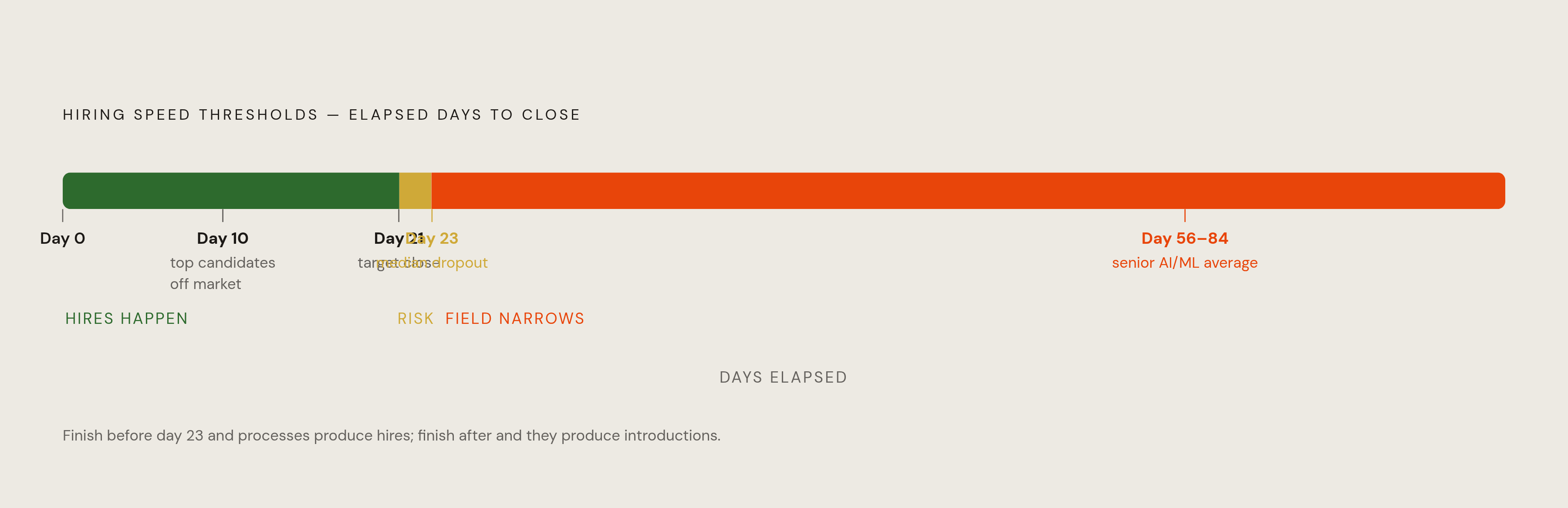
A salary range that candidates trust can get their attention but cannot make them wait. Top engineers can have other offers while a startup is still setting up its next interview. Delay therefore changes who remains available, even when nobody makes an obvious mistake. A platform’s process design belongs in the initial evaluation because it can help sustain interest long enough to produce an accepted offer.
The median 23-day dropout point is not a safe operating target. The best engineers can leave open processes within a 10-day availability window. A loop that finishes before the median can still be too slow for the most sought-after candidate. Likewise, the 8–12 weeks needed on average to hire senior AI and ML talent is not a reason to keep one candidate interviewing for that long.
Hiring processes that take 21 days or less show that a company runs well and turn more candidates into hires than those that take much longer. Speed also tells candidates something about the company itself. Founder-led processes that close quickly can show how decisions get made, while drawn-out loops suggest friction before the engineer has joined. The platform test is therefore not simply whether it can generate introductions, but whether its design supports a decision while those introductions are still live.
What a process loop that closes inside the dropout window looks like
For a founder designing the loop, the practical implication is to commit to its shape before the first application arrives. The process should fit the time the candidate has, rather than grow longer as the company finds new questions to ask. Assessment still has a place in that window. Paid trials or practical working sessions work as a final stage, rather than as an early hurdle before either side knows whether the role is a good fit.
The final stage must also be proportionate. Monster’s report found that candidates are still willing to do assessments when the process feels fair and reasonable. The same report found that a majority would be least likely to apply to postings requiring unpaid assignments or excessive take-home work. Those findings are not contradictory. A focused working session near a decision asks for a different commitment from a large unpaid assignment at the start.
A founder can publish the compensation context and intended process together, allowing the engineer to judge both the opportunity and its cost in time. That is part of the offer’s credibility. A fast loop is not one that merely claims urgency while leaving the candidate unable to see what comes next.
How do founders choose recruiting platforms with upfront salary ranges and fast hiring?
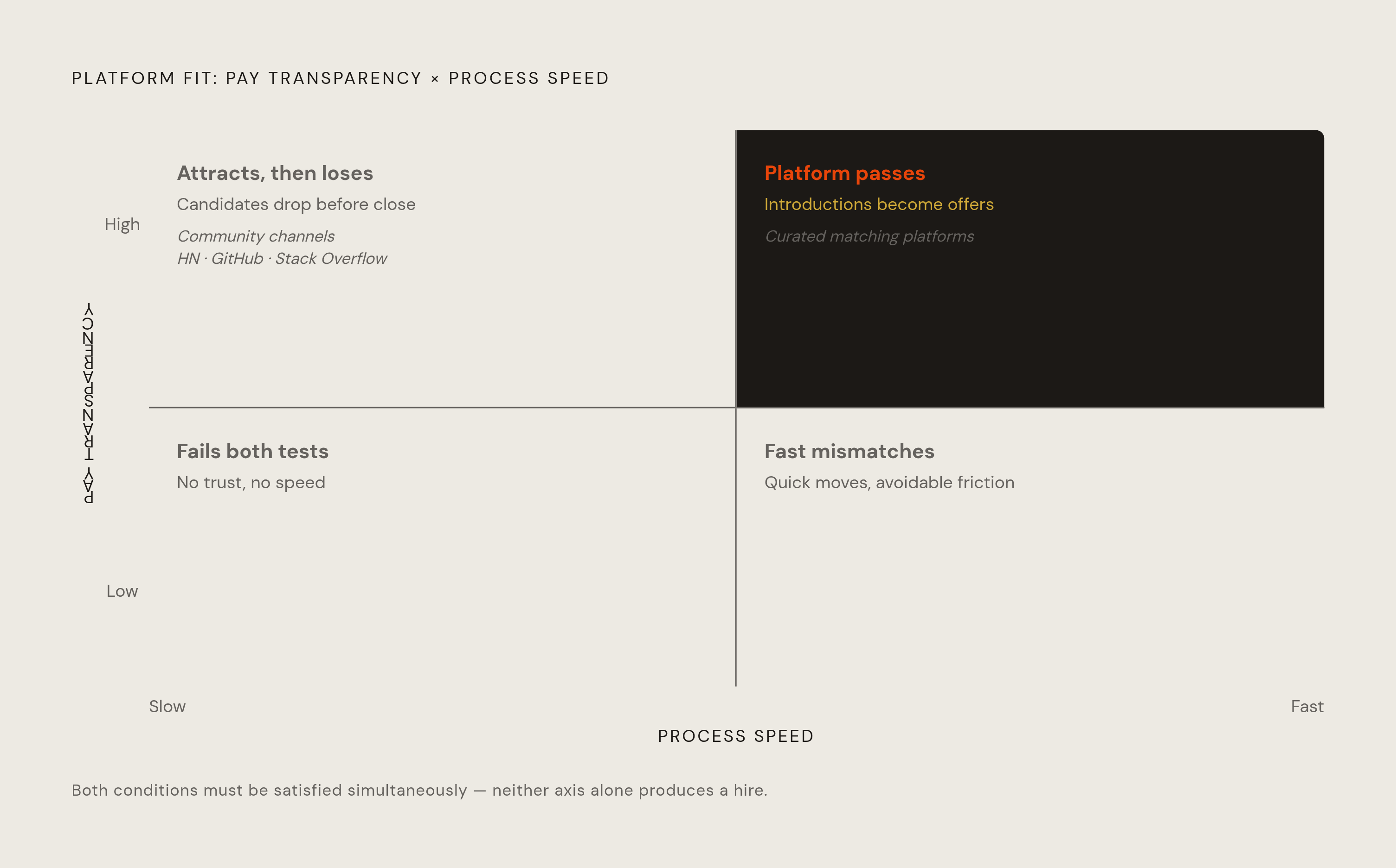
Both conditions must hold for a platform to pass the filter. Credible compensation without a workable timeline can produce candidates the company loses before deciding. A quick loop without pay context can move a mismatch rapidly toward an avoidable negotiation. Neither is enough on its own. The comparison has to connect what candidates learn before engaging with what happens once they do.
Community channels such as Hacker News “Who is Hiring?”, GitHub, and Stack Overflow can provide strong founder-engineer trust rooted in actual work and contribution beyond keyword matching. They suit founders who value that context and can control the hiring process themselves. Speed remains the founder’s responsibility. Access to a trusted community does not, by itself, compress the interview loop.
Curated matching platforms that deliver salary bids upfront and treat hiring speed as a product requirement offer a different fit. Their premise aligns with both tests, because compensation context is structural and speed is part of the design. They suit founders who need to hire fast and want that help rather than having to keep the process on track entirely on their own. Across either category, the deciding question remains whether the platform can present compensation, equity structure, company stage, and the technical problem while supporting a timely close.
The strongest objection: early-stage founders who cannot compete on cash
Some early-stage founders cannot match the salaries that AI-native startups backed by tier-one venture firms offer at seed stage. A smaller round creates a real cash constraint. Publishing a below-market range can screen out engineers the founder would love to hire, even when the work is strong. Being open about pay still leaves the startup at that disadvantage, and advice that ignores it does not help.
Hiding the gap postpones the point at which the candidate discovers what the startup can pay. The answer lies in the rest of the opportunity. Top AI candidates have turned down much larger offers for a clear mission, hard problems they truly own, equity upside with secondary liquidity options, and the chance to ship fast.
For a founder with that constraint, platform selection should make those other dimensions visible without disguising the salary. The base range should sit alongside the equity structure, company stage, and the specific technical problem. An engineer has a reason to accept the trade-off if those dimensions offer enough substance. A platform that can present the full package is more useful than one that makes a salary field easy to fill in but leaves the startup’s strongest reasons to join out of view.
What the two-axis filter produces before a single job description is written
The founder has a shorter platform shortlist, a defined compensation package to explain, and a hiring loop agreed in advance. Role type and urgency shape which platform survives that comparison. The job description then executes a decision about who the company is trying to reach and how it can credibly hire them, rather than becoming the place where those decisions are improvised.
The engineer encounters the result as a clearer choice. The technical problem, compensation band, equity structure, and company stage are available before a large investment of time. The intended process shows whether the company can make a decision within the engineer’s window. Both sides are checking credibility before committing. When the founder has already done that work, the candidate can spend the interview deciding whether to join instead of discovering what the opportunity actually is.