Why Founders Who Post Salary and Timeline Up Front Win Engineers Before Competitors Schedule a Screen
Posting pay and timeline early lets AI startups close engineers faster.

For AI startups hiring engineers quickly, publishing a real salary band and hiring timeline at the top of the listing removes two reasons candidates delay committing. Founders who also approve compensation internally before the first screen can move from evaluation to offer without reopening basic terms. The advantage is not simply more applicants. It gives engineers enough to go on to choose before a slower competitor has even set up a conversation.
Why elite engineers filter job postings before they ever engage with a company
An engineer with competing offers has limited time to discover whether another opportunity is worth pursuing. Salary is an early filter, much like remote work or the tech stack. A role can look interesting and still fail that filter. Senior engineers have little reason to invest three weeks in interviews if the final number might fall below what they need to move. They need enough information to rule an opportunity in before giving it that time.
Reading a range takes far less work than going through all the interviews. When an engineer already has several options, an unknown salary leaves more to guess at and gives them no more reason to talk. The missing number becomes part of the assessment.
From the engineer’s perspective, that omission can suggest an employer does not know its market position, pays below market, or lacks a compensation structure. None is a reassuring starting point for a move. Those interpretations need not be correct to affect the decision. Without a range, the reader cannot easily distinguish an attractive opportunity from one that will end in a mismatch. Skipping the posting preserves time for opportunities that can already be compared.
How the legal cascade turned salary posting from a progressive practice into a baseline expectation
Pay transparency requirements have spread far enough to change what candidates expect to see. By mid-2026, more than 25 state and local jurisdictions had active requirements. Illinois, Minnesota, New Jersey, Vermont, and Massachusetts added laws that took effect in 2025. Virginia and Maine followed with requirements in July 2026. This is no longer a practice confined to a few unusually open employers.
Remote hiring extends that pressure beyond an employer’s home state. Applicable rules can follow where a remote role is offered, so incorporation alone does not settle which requirements apply. For AI startups recruiting engineers across states, salary disclosure is therefore more than a local policy question. A posting without numbers sits next to postings where those numbers are readily available.
That wider availability changes the meaning of an omission. Candidates can compare disclosed opportunities first and leave uncertain ones for later, if they return at all. Withholding a range is now a visible choice.
Why the 23-day window means information delay is not just a friction cost — it is a candidate-loss mechanism
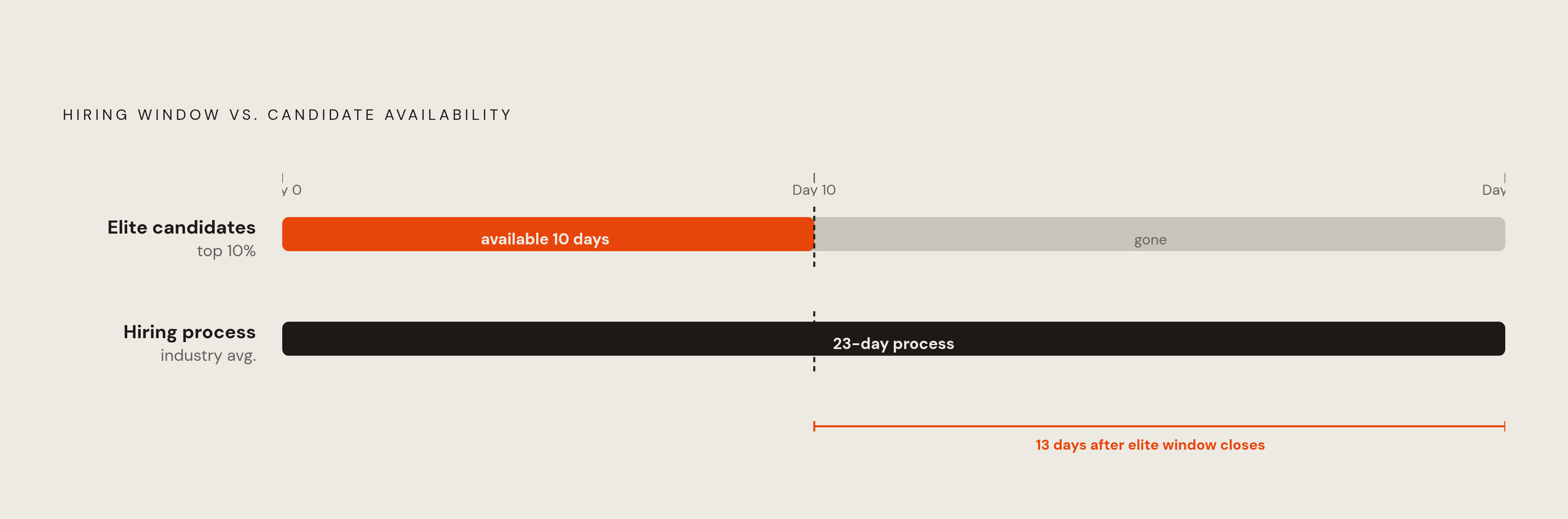
The 23-day window frames the central hiring risk. Strong candidates can drop out within weeks, while an employer is still working out details it could have settled before it began recruiting. The fastest-moving top candidates may remain available for only 10 days, well short of the industry-average time to fill an AI/ML role.
That changes what a delayed salary conversation costs. If neither side knows whether the compensation will work after several rounds, the candidate must keep other options open while the founder spends time assessing them. AI talent often weighs more than one offer at a time. A competitor that resolves salary and timing earlier gives that engineer something concrete to assess, rather than another process with an uncertain destination. The loss is not merely a few days on a calendar.
Speed also communicates how a company makes decisions. Candidates can read a fast, transparent process as evidence of decisiveness, while a slow or opaque one suggests similar problems after joining. The process itself contributes to the comparison alongside the role’s appeal. A founder is showing how the organization works before the engineer has agreed to work there.
Compensation readiness is the biggest company-side accelerator in this mechanism. When the range is approved before the search, an offer can go out the day the interview loop ends. Without that alignment, the company starts another negotiation internally just as the candidate is ready to decide externally. Those conversations run on different clocks. The founder may still be debating a number when the engineer accepts another offer.
What engineers actually do with a posted range — and why a wide or vague range fails the same test as no range
Engineers do more with a salary band than check its highest number. A band has a minimum, a midpoint, and a maximum, with the midpoint representing market rate for a fully competent performer. Its spread, which widens with seniority, provides another clue about the role. Where an offer falls within that band gives the candidate a clue to the level being offered and where the pay sits. The range is a map.
That map needs enough detail to be useful. An excessively broad range leaves the engineer unable to judge what the specific role is likely to pay. A “competitive salary” placeholder leaves the same question unanswered. Like “fast-paced environment” in a culture description, it substitutes a familiar phrase for information the reader could assess.
A point salary, where the minimum and maximum are identical, can fail for a related reason. The notes identify it as a common compliance-without-intent pattern that candidates with options skip. An engineer still needs to understand the level and where the proposed hire would fit. Otherwise, the uncertainty has merely moved from whether a number exists to what it means.
The internal-equity objection is that publishing a tight range before reviewing existing pay can expose inconsistencies that the company has not resolved. The lesson for founders is to complete the internal review and alignment before posting.
What the founding engineer market looks like when a founder posts range and timeline up front versus when they don't
Founders hiring a founding engineer face these pressures with few candidates to choose from. Cash compensation has risen sharply, equity grants have tightened, and passive outreach is required for nearly every search. These engineers are not necessarily looking for another interview process. A passive-open candidate may be willing to move, but needs a reason to spend time finding out whether the role is a fit. Missing information can end that consideration before a conversation begins.
Base salary has particular weight in this comparison because candidates price dilution risk into their cash requirements. Equity does not make the base number optional. When a founder withholds it, the engineer has to assess the opportunity without a central part of the package. The candidate may assume the worst while clarity is still missing. That is a costly ambiguity when there are few suitable people to approach.
The contrast becomes concrete at the first interview. A founder-led conversation within five business days, backed by a pre-approved compensation band, correlates with dramatically higher offer acceptance. Information alignment lets the candidate weigh the role with the terms in hand while there is still time to decide. A slower competitor may have an attractive opportunity but has not yet made it equally possible to assess.
When compensation stays unclear and hiring drags on, there is a serious risk that counter-offers will draw away a candidate who was close to accepting. Recruits Lab’s 2026 AI Hiring Report identifies counter-offers as the largest cause of post-offer fallout specifically within its proprietary dataset. That distinction limits the claim without weakening the underlying risk. An engineer who has not committed remains open to a current employer or a faster-moving alternative. Time spent withholding basic terms gives those alternatives room to develop.
How to hire engineers quickly with upfront salary and timeline transparency
GitLab shows how it works out compensation before someone applies. Its public calculator works out pay with the formula SF benchmark × Location Factor × Compa Ratio × Exchange Rate × Level Factor. Candidates can look up compensation for a role, level, and location themselves. The same public handbook documents the interview timeline.
Anthropic illustrates a different part of the pattern. It publishes salary ranges on most US postings, with distinct ranges for titles including software engineer, research engineer, and research scientist. The interview loop can still take several rounds over several weeks. Early disclosure therefore means basic compensation fit need not remain unresolved until the offer.
HubSpot makes career-level expectations visible through its published engineering performance rubric. The criteria run from Software Engineer through Principal and explain how people move between levels named for job titles, in place of an IC1–IC5 designation. Its compensation bands are not officially published.
GitLab exposes pay calculations and process timing, Anthropic supplies title-specific salary ranges, and HubSpot explains level expectations. No single element answers every candidate question. Taken together, the useful package is a range, an explanation of where a hire would land, clear level logic, and a timeline.
For founders without a public calculator or extensive leveling documentation, the minimum viable version is smaller. The posting should state a tight, meaningful band, the specific role level it covers, the number of interview rounds, and when an offer would go out. That is enough to replace basic guesswork with terms a candidate can evaluate. It also gives the founder a process commitment to honor.
How the matching layer amplifies what upfront posting starts — and where most founders still lose the race
Curated matching platforms can extend this approach when they establish salary expectations before introducing candidates. Pre-screening leaves less to find out in the first conversation, and interview requests with bids upfront show right away what the pay could be. The useful distinction is what is already known at introduction. A match with established expectations begins closer to a decision than an introduction that leaves compensation entirely open. More introductions alone do not close that gap.
For an AI startup evaluating a matching service, those are concrete comparison criteria. The relevant questions concern whether candidates are pre-screened, whether salary expectations are established, and whether interview requests include an upfront bid. These features address the same uncertainty that a transparent posting addresses. They are not substitutes for a real range or an explicit timeline. An outside matching layer also cannot settle disagreements within the company that is hiring.
That is where a transparent search can still stall. A founder may publish a credible range and attract a strong engineer, only to lose time to compensation approval, leveling disputes, or a multi-stage loop that outlasts the candidate’s availability. The posting has done its job by starting an informed conversation. The organization then fails to act on the terms it presented.
Upfront disclosure is therefore a commitment device that puts the compensation conversation before the first screen and makes the promised timeline part of the candidate’s decision. Founders who close quickly still need a role people want and an opportunity they believe in. Their operational advantage is that the internal work is already done, so a positive evaluation can become an offer while slower competitors are still arranging a screen.