Investor Quality as a Signal for Startup Career Bets
Investor quality matters for career decisions, but only if you read it correctly for your own risk.

Advertisement
An engineer with a signed offer in hand is making a bet with no financial model, no board access, and no inside view of the cap table. Investor quality is one of the only public signals available to fill that gap, but it was built for a different reader. Founders and venture capitalists read it for their own purposes, and an engineer who borrows their lens without adjusting it will misread what the signal actually says.
Reading Investor Signals as an Engineer
A founder lists investors on a website to signal credibility to customers, future hires, and the next round of backers. A VC reads another fund's involvement to benchmark deal quality against their own pipeline. Neither of those is the question an engineer needs answered.
The engineer's question is narrower and more personal. Does this company have a high enough probability of surviving, scaling, and rewarding equity to justify the salary and optionality being given up to join it? That question can be answered in part from investor data, but only by someone who knows which parts of the signal carry real weight and which parts are decoration.
The stakes of getting this wrong are rising. Capital in the AI funding market is concentrating sharply at the top, and the gap between well-backed companies and poorly-backed ones is wider now than at any prior point in the startup cycle. A well-funded competitor with a thin idea can out-hire and out-ship a scrappier company with a better one. Reading investor signal correctly is no longer a nice-to-have for career decisions; it is a basic risk filter.
What "Investor Quality" Means
Investor quality gets treated as a single prestige ranking, a name recognized enough to feel safe. That is the wrong frame. Investor quality is a bundle of separate, checkable attributes, and each one tells a different part of the story.
Fund tier measures whether the lead investor has a track record of backing companies that reached meaningful exits, not whether the name shows up in headlines. Stage fit measures whether the fund's typical check size and stage match the round being raised. A growth fund leading a seed round sends a different signal than a dedicated seed fund doing the same thing, even if both checks are the same size.
Technical diligence depth matters more in AI than it did in prior startup cycles. AI-dedicated funds often bring in-house ML engineers or technical advisors to stress-test model performance and defensibility before writing a check. Generalist funds lean more on market size and founder pattern-matching. An engineer evaluating a deep-tech company should ask whether a fund that actually evaluated the technology said yes, or whether the check came from a fund betting on the category in general.
Conviction signals round out the picture: whether the lead investor took a board seat, whether they led alone or folded into a crowded syndicate, whether they followed on from a prior round. Each of these facts is checkable, and each says something different. Investor quality is a proxy for the rigor of the process that let the company into a more favorable distribution of outcomes in the first place, not a stand-in for its eventual success, and that distinction sets up the most important idea in this piece.
The selection effect: why the signal is probabilistic, not predictive
Elite investors correlate with better outcomes, but not because their involvement makes companies succeed. Their diligence selects for companies that were already more likely to succeed before the check was signed. A company backed by Sequoia does better on average because Sequoia's filter only admitted stronger companies, not because Sequoia's name on the cap table changed the company's trajectory afterward.
That distinction changes what the signal can tell an engineer. It confirms that the company cleared a high bar of scrutiny from someone with money on the line and an incentive to be right. It does not guarantee the company will succeed.
Take seriously the strongest objection to using this signal at all: investor quality is lagging and noisy. Even tier-1 backing captures only a fraction of eventual winners, and plenty of future successes get passed over or missed entirely by every fund in the room. That objection is correct, and it does not mean the signal should be thrown out. It means the signal should be used as a filter that narrows a distribution of outcomes, not as a forecast of what happens to any single company.
Luck and market timing shape outcomes in ways no investor's diligence process captures. An engineer should hold that uncertainty directly rather than hiding it behind a fund's brand name, as if a logo on a slide deck could cancel out the randomness of a market. The signal becomes genuinely useful once it gets stacked against other observable facts about the company. The rest of this piece covers how.
What funding stage reveals about survival risk
Stage is the most legible piece of investor data an engineer can check, because it tells you directly what survival-probability distribution the company sits in, and that distribution drives the equity math that follows.
Early-stage equity is worth close to zero in expectation. Most seed-funded startups fail before reaching a Series A, and among the ones that survive, only a small fraction return meaningful value to employees holding options. Tier-1 investor presence at seed doesn't change those raw odds dramatically, but it does pull the company into a subset of seed-stage companies with better odds than the pool at large. That's a real improvement in expected value, just a modest one.
Series A is where company plans get rewritten. Priorities shift after the round closes, and the company stays in a high-uncertainty phase for a while longer. What changes at this stage is conviction: a strong lead investor who takes a board seat at the A has made an active, ongoing bet rather than a one-time selection decision made during diligence.
Series B and beyond signals something different again. The company has demonstrated enough traction to earn a second or third institutional check, and survival risk drops accordingly. Upside compression sets in at the same time: later equity, priced at a higher valuation, has less room to grow relative to where it started.
Watch for the stage jump itself as its own piece of information. A company moving from seed to Series A with the same lead investor following on sends a materially stronger signal than a company raising its Series A from an entirely new set of investors, because follow-on conviction from an existing backer carries more weight than a fresh name entering cold. Each stage, and each hire that stage brings on, compresses the percentage an engineer can realistically negotiate. Stage sets survival odds and sets the ceiling on what an engineer's equity grant is actually worth.
The Investor Syndicate, Not Just the Lead
The lead investor gets most of the attention, but the full syndicate around that lead carries information the lead's name alone can't convey. Who joined, at what size, and whether any of them have an operational stake in the company's success all add detail to the picture.
A syndicate that includes strategic investors, companies with a direct operational interest in the startup's success, signals something different from a syndicate made up entirely of financial investors. Strategics diligence a deal with more than return modeling in mind, since they have their own business reasons to want the bet to pay off.
Together AI's Series C shows this structure clearly. Aramco Ventures led the round, with Vista Equity, General Catalyst, Nvidia, Emergence Capital, March Capital, Pegatron, and S Ventures all joining the syndicate. That mix of financial and strategic capital is itself a signal about staying power: a company with backers who have operational reasons to keep it alive is positioned differently than one with a single financial sponsor.
Compare that to a syndicate stitched together from small checks and names an engineer doesn't recognize. That pattern points to diffuse conviction, no investor holding enough ownership to care deeply about the outcome, a materially different situation from a concentrated bet backed by a board seat.
Before accepting an offer, an engineer should be able to answer a short set of questions about the syndicate. Who led the round? Did the lead take a board seat? Are any of the strategic investors companies that might buy or partner with the startup down the line? Did any of the prior-round investors follow on into this one? The answers tell you more about staying power than the lead investor's name does on its own.
Accelerators as a floor-level investor quality signal
Not every company an engineer evaluates has raised from a named VC yet. Accelerator participation fills that gap. It functions as a standardized, verifiable filter that narrows the pool of early-stage companies down to ones that passed a known selection process.
Y Combinator is the clearest example of this. Its selection process is public, its network effects among founders and later-stage investors are documented, and its survival rate runs materially higher than the startup industry average. That makes YC batch membership a genuine signal, not just a line on a pitch deck.
The accelerator signal sits below a tier-1 Series A lead in strength, an earlier and weaker read on the company, but it still beats having no institutional vetting. For engineers evaluating pre-seed or seed companies that haven't yet raised from named VCs, accelerator participation is often the only legible external validation available at that point in the company's life.
The limitation is specific: accelerator alumni status alone doesn't distinguish a standout batch company from one that barely made it through demo day. Software-layer companies built on top of a foundation model's API face a separate risk entirely, the chance that the underlying model provider eventually ships the same feature natively and absorbs the startup's whole value proposition. No accelerator credential protects against that. Stack the accelerator signal with what happened after the program ended: ARR growth, follow-on investors, and the hires the company has made since.
Stacking Investor Quality with ARR and Team Pedigree
Investor quality reaches its highest usefulness when it confirms what ARR trajectory and founding team pedigree already suggest on their own. It is weak when asked to stand in for those facts.
ARR is the cleanest independent signal available because it isn't a selection effect. A company earning real revenue has demonstrated a fact about the market, not passed someone else's filter. Replit's trajectory shows what this looks like stacked against investor backing: the company raised $400 million in March 2026 at a $9 billion valuation, a threefold increase in just six months, and is on track to hit nine-figure run-rate revenue by the end of 2026. For an engineer evaluating a role there, the tier-1 backing and the ARR trajectory together form a signal stronger than either fact would be alone.
Founding team pedigree adds a third independent layer: prior company experience, depth in the relevant domain, and evidence of having shipped at real scale before. The strongest position an engineer can find combines a tier-1 lead investor with board-level conviction, ARR growth that reflects genuine customer demand, and a founding team with direct domain experience. Any two of the three make for a reasonable bet. Any one alone is a weak position to join on.
This matters even more for a founding engineer role, since joining as engineer number one ties the company's early trajectory directly to an individual's own trajectory. That raises the cost of misreading these signals before signing an offer.
The logic runs in reverse just as cleanly. A recognizable investor name, no revenue, a founding team with no relevant background, and a product that's really a thin layer on top of a foundation model's API describes a company where investor pedigree is carrying the entire pitch. That's not enough on its own to justify the bet.
Sector-level investor concentration as a career positioning signal
The same investor-reading skill applies above the level of a single company. Where tier-1 and specialist investors are concentrating their bets, at the sector level, tells an engineer more about durable long-term opportunity than any individual company's pitch deck will.
The AI funding market right now is bifurcated. Capital is concentrating sharply in infrastructure, physical AI, and foundation model companies, while software-layer companies built on top of third-party APIs carry the feature absorption risk described above. A robotics company's round illustrates where the specialist money is going: the company, backed by a major investor, raised a very large round in January 2026 at a multi-billion-dollar valuation. A bet of that scale, from investors with the technical diligence capacity to evaluate robotics specifically, says something about where specialist capital thinks durable value is being built.
An engineer deciding where to point a career, not just which single offer to accept, should track this pattern across a sector over time. Aggregate investor behavior is a better guide to where to develop skills and where to search for the next role than any one company's pitch, because it reflects the collective judgment of people whose job is to find durable value before it becomes obvious.
What a funding announcement tells you about hiring timing
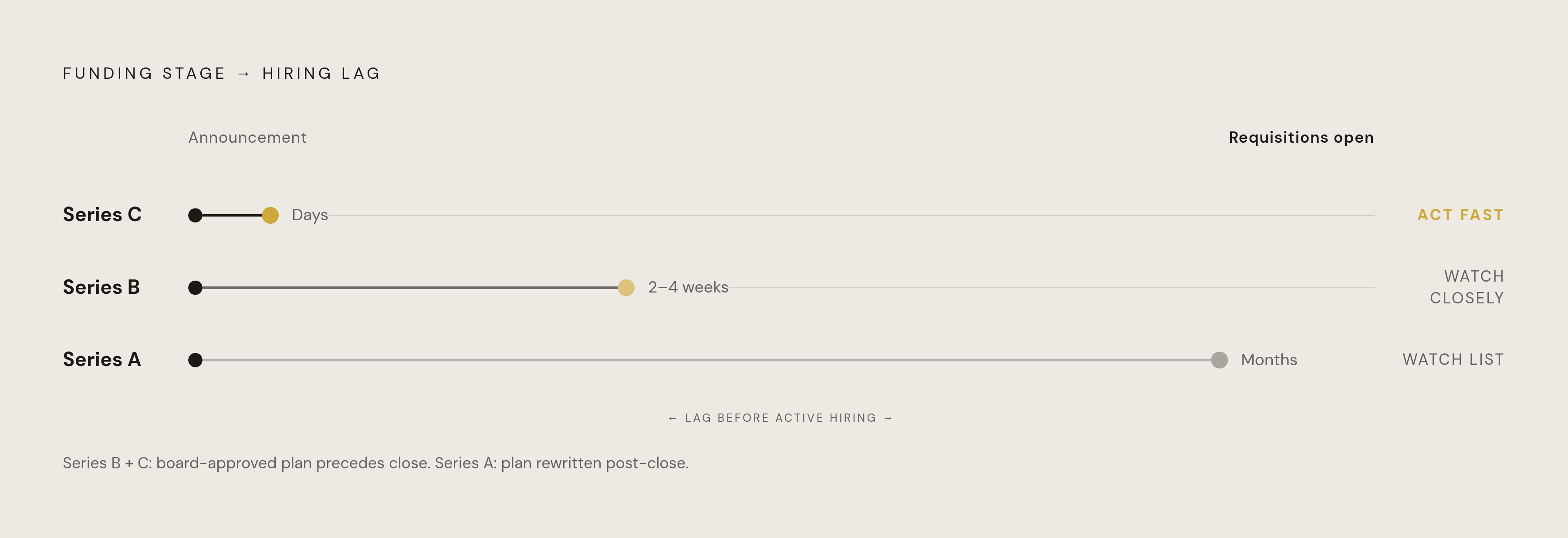
A funding announcement opens a hiring window, and that window moves at different speeds depending on stage.
A Series C company typically has a board-approved hiring plan in place before the round even closes, so job requisitions open almost immediately after the announcement. A Series A company, by contrast, tends to rewrite its plan after the round closes, which stretches out the lag before hiring activity actually begins.
For an engineer tracking a sector of interest, this difference sets the order of attention. Series B and C announcements in that sector deserve the highest-urgency follow-up, since the hiring window behind them opens fast and closes before most candidates notice it. Series A announcements belong on a longer watch list instead, tracked over time rather than acted on immediately, since the hiring activity behind them takes longer to materialize.