How Founders Engineer the Referral Network That Surfaces the Right Hire Before a Role Is Posted
Founders who build trusted relationships early hire better.

Invitation-style recruiting finds engineers through introductions from people who are trusted. For founders, it works when recurring contact, credible referrers, and a real presence in engineering communities bring the right person into view before a role is posted. The best technical hires are not simply lucky referrals. They come from a network built before the company needs it.
Why the best technical hires happen before a role is posted
A seed-stage founder has to hire while shipping product, talking to customers, and raising money. Hiring competes with all of it. A trusted introduction gets attention because it comes with the judgment of someone who knows the engineer, which a public application alone cannot offer. That judgment helps the founder choose whom to assess in the little time they have.
Founders often triage by turning to referrals and direct introductions first, reaching into the application stream only when warm channels run dry. As a result, some of the most consequential early technical hires take shape before anyone writes a job description. The relationship precedes the vacancy.
The founding engineer role makes that pattern especially clear. This person is typically among the first few technical hires, with meaningful equity and direct input into architecture and product direction. The stakes are high on both sides. A founder wants to know what an engineer can do and how well they make decisions, while the engineer is being asked to join a company still taking shape. An existing relationship or trusted referral gives that conversation a head start that a posting cannot manufacture.
Why referral-first thinking becomes a trap without deliberate architecture
Referrals genuinely work for the first two to four hires. That success can teach the wrong lesson. A founder texts former colleagues, meets promising people, and decides that a good address book is all the hiring system they need. Around hire five through fifteen, however, the roles become more varied than the founder’s personal network can support.
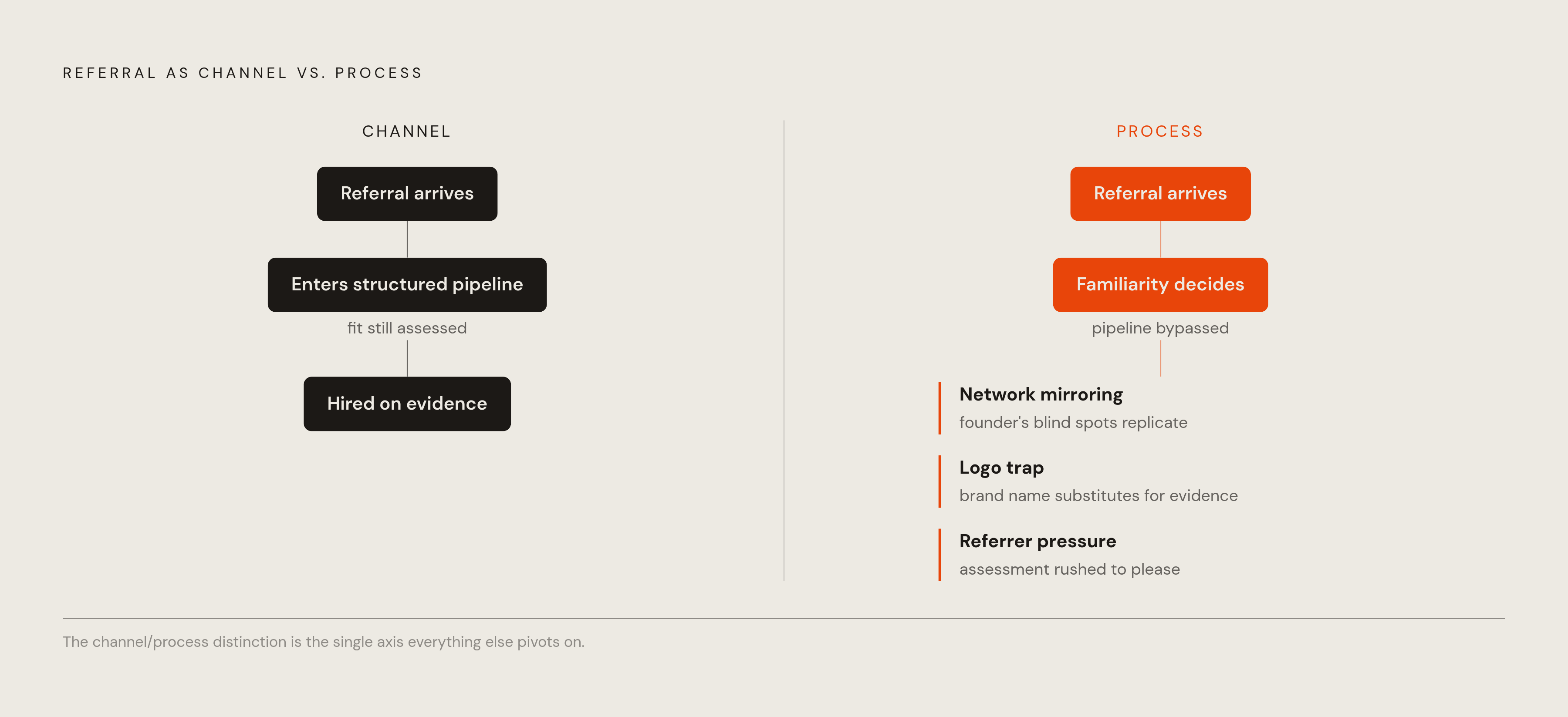
A network often mirrors the founder’s background, so relying on it alone can produce a team with predictable blind spots. Familiar company names can also become substitutes for evidence of individual competence. This is the logo trap. Meanwhile, pressure to please the person who made a friendly introduction can rush the assessment, making a fast hire seem like a good hire.
The distinction is between referrals as a channel and referrals as the entire hiring process. As a channel, they bring candidates into a structured pipeline where fit still needs to be assessed. As a process, they let familiarity decide who gets considered and how closely that person is examined.
The apparent savings can therefore be misleading. Referral hiring may have no upfront placement fee, but a prolonged search or wrong hire still costs time and opportunity. Founders need to keep building relationships that lead to referrals and judge each candidate apart from their ties to the person who introduced them. That means reaching beyond the people a founder happens to know, without abandoning the trust that makes referrals useful.
The network audit — mapping what already exists before building anything new
To build that system, start with a spreadsheet. Map former colleagues, university connections, side-project collaborators, conference contacts, and respected technical Twitter/X mutuals. Then sort them by recency of contact. Founders often underestimate the reach of these existing relationships because the connections are scattered across different parts of their lives.
Recency is only the first sorting rule. Then sort people into those who know the founder well enough to refer with confidence, trusted nodes who know engineering circles the founder cannot reach directly, and those who need to hear from the founder again before being asked to help with hiring. These are different kinds of relationships. Treating them as one undifferentiated contact list hides where trust already exists and where it still needs work.
Before asking anyone about an opening, spell out the role. A vague request for a good engineer gives the other person little to go on when choosing whom to introduce. It also spends relationship capital on conversations that may go nowhere. The audit can happen before a vacancy exists, but a request for candidates needs a clear account of the work and the person suited to it.
Investors belong on the map as well. Angels and early VCs know engineers considering their next move and have a direct financial incentive to help the company succeed. Ask each investor for three engineer introductions. Then, as the team grows, sit with each new hire on day one and review their connections for possible candidates.
Building recurring touchpoints so referrals surface without a prompt
Once the map exists, put a recurring weekly block on the calendar to maintain it. This is the keystone habit. Without time set aside, founders tend to get in touch only when they feel pressure to fill a role, so every conversation starts with a request. A weekly rhythm makes room for relationships to develop before they have a hiring purpose.
The format can stay simple and varied. A coffee with an engineer at an adjacent company, a conversation at a hackathon, or a useful contribution in a technical Slack or Discord community can all serve that rhythm. The venue is secondary to the continuity. Engineering contacts need to hear from the founder and about the company often enough to remember them when someone talks about a possible move.
That familiarity takes months or years. A founder who appears only when hiring may be known personally but absent from the conversations where opportunities first surface. Consistent contact closes that gap.
Giving keeps that contact from becoming a disguised request. Make introductions, share job leads for positions the company is not filling, and pass along useful signal on candidates who were not a fit. Those acts help other people find hires or work through problems in their careers. They also make the relationship worthwhile when there is no opening to discuss. The discipline is not to ask more often, but to remain useful between asks.
Identifying and cultivating trusted nodes — the people who refer at high signal
Keeping in touch with everyone keeps relationships alive, but some contacts can do more than others to help with referrals. Trusted nodes are people who know engineering circles that a founder cannot reach just by contacting people directly. The next layer of the system is deeper investment in a small number of them.
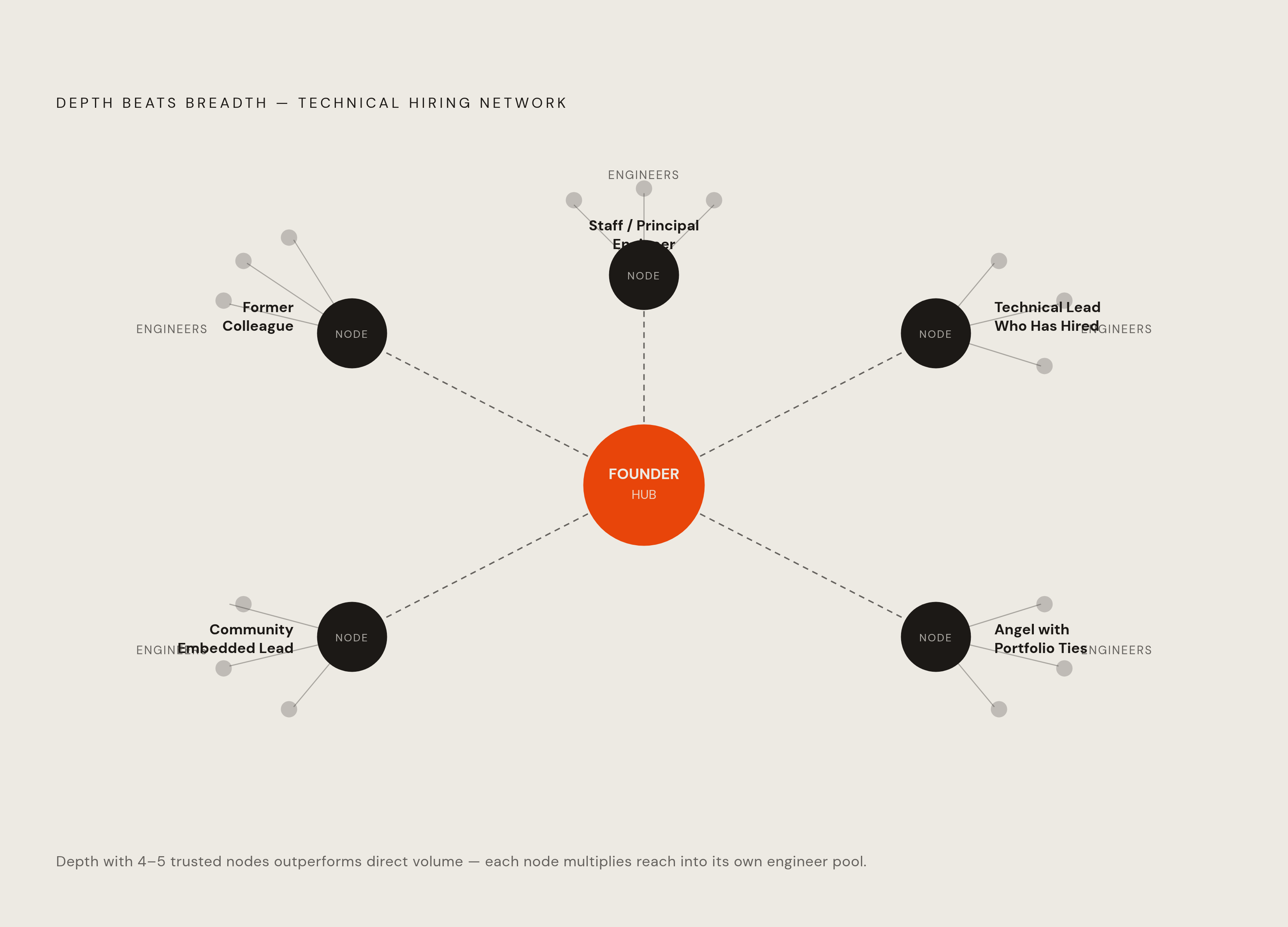
Staff and principal engineers at high-growth startups can fill this role, as can technical leads who have hired large teams. Former colleagues deeply embedded in engineering communities and angels with direct portfolio relationships can also connect a founder to relevant candidates. Their value is not merely access. Their reputation with engineers gives an introduction credibility that an unfamiliar sender cannot borrow simply by writing a better message.
The founder’s relationship with the referrer must be warm, too. A loose LinkedIn connection may know the right person without knowing enough about the company to make a convincing introduction. Depth changes the quality of that judgment. A referrer who understands the founder’s technical decisions and hiring bar has a firmer basis for deciding whether a particular engineer belongs in the conversation.
To develop that understanding, share early technical decisions and ask for an honest read. Invite trusted nodes to review architecture choices or give candid product feedback. These exchanges help both people respect each other through real work. A meaningful equity referral bonus for a successful hire can also recognize the value of the introduction, with a cost that may be small compared with the time saved.
In this hub-and-spoke design, the founder stays closely connected to a few people who are themselves connected to relevant pools of engineers. Trying to stay that close to hundreds of contacts spreads the founder’s time across too many people.
Showing up in engineering communities the right way — presence before pitch
Trusted nodes extend a founder’s reach, but they do not replace participation in communities where new relationships can form. In technical communities, founders can meet passive candidates who may never look at a job board. Access alone does not earn attention, though. Engineers are good at detecting participation that exists only to turn them into hiring prospects.
When a founder joins a technical Slack group, Discord server, or engineering subreddit and posts a hiring pitch right away, members can see why they joined. The community becomes a job board in the founder’s eyes, even though its members came for something else. Little response should not be surprising. A hiring message has no established relationship behind it, so it is effectively cold outreach delivered in a shared room.
The practical alternative is contribution before recruitment. Over weeks or months, answer questions, share resources, and speak honestly about technical topics. Choose communities built around technologies, frameworks, or problem domains that matter to the company’s stack. That relevance gives the founder a reason to participate even when the team has no vacancies, which is the clearest difference between genuine presence and a prolonged pitch.
The same principle applies outside chat groups. In-person events and hackathons in SF and NYC, as well as open-source projects adjacent to the company’s technical work, offer places to build familiarity through contribution. The goal is to become a credible answer when an engineer asks a peer who is building something interesting. That is how a conversation about work can become a referral before a role is posted.
What the system looks like when a role actually opens
When a vacancy appears, a founder with this network does not start by assembling an audience. The relevant relationships already exist. The founder knows which trusted nodes to contact, and those people already understand the company, its technical choices, and the standard expected of a hire. A clear role brief tells them what they still need to know, without making them learn the whole business from scratch.
The resulting introductions are different from a batch of names. They arrive through people who can explain why the engineer and company should speak, with credibility on both sides of the conversation. That can produce a warm shortlist within days. For senior engineers who are not browsing job boards, the entry point is an invitation to discuss relevant work.
Strong passive candidates are not necessarily considering only one company, and taking three weeks to respond to an introduction can surrender the advantage to a faster-moving founder. Trust does not hold a candidate indefinitely. Moving promptly means preserving the opportunity to evaluate them, even when a respected person supplied the name.
The question at this point changes from where to start looking to which person already within reach is closest to the required fit. That is a concrete operational difference. Turning an eight-week cold search into an eight-day warm-network hire shows how much time this could save, though results will vary by role. The proactive founder has done the relationship work before the clock starts, while the reactive founder must build trust and fill the vacancy at the same time.