What Separates a Tier-1 From a Tier-2 AI Startup
Four signals separate AI startups that win from those that merely survive.

An engineer picking between two AI startups is usually comparing the wrong things: funding round size, logo recognition, the number of people talking about the company on social media. It doesn't tell you which tier the company sits in. The AI startup world has split into two groups: a small cluster of companies with real structural advantages, and a much larger group that looks similar from the outside but sits in a fundamentally weaker competitive position. That split appears in what matters most to an engineer's career: how much the equity ends up being worth, how fast someone learns on the job, who they work alongside, and whether the problems they spend their days on are worth solving. Four things separate the two groups: how specific the revenue is, who backs the company, how much talent it's pulled in, and whether it owns a workflow deeply enough that customers can't walk away. Learn to read those four signals and evaluating a startup starts to look a lot like how a sharp investor sizes one up.
Revenue specificity as the first separator between tiers
The strongest companies right now didn't set out to build "AI." They found one workflow that was slow, expensive, and painful to live with, then built something precise enough to fix it and get paid well for the fix. That precision is what makes the business survive contact with a real procurement process. A finance team can approve a tool that cuts a defined cost on a defined task even when budgets are tight. A finance team cannot approve "a general AI capability" with the same ease, because there's no number to point to.
That's the real contrast in this market: companies selling AI as a broad capability (generic text generation, copilots that do a little of everything) against companies selling AI as an outcome (cut this specific cost, speed up this specific decision). Harvey, built for legal and professional services work, and Sierra, built for enterprise customer service agents, both reached substantial valuations by doing the second thing. So did ElevenLabs, valued at $11 billion in generative voice. All three let a customer stack software spending directly against the labor or professional cost it replaces, and that comparison is what makes the deal easy to close. Cognition, which builds autonomous AI agents for software engineering, shows the same pattern holds even without a foundation model behind it. The advantage is owning the workflow, not the model.
A startup whose pitch amounts to "we can do a lot of things with AI" is weaker than one that says "we eliminated this specific cost for this specific buyer," even if the first company's demo looks flashier. When a startup can't name the workflow it owns and the number attached to fixing it, that's a strong sign the company sits in the weaker tier.
Investor caliber as a structural input, not a vanity metric
Who leads a startup's round isn't a badge. It determines what the company can do next: whether follow-on capital arrives when it's needed, whether enterprise customers take a cold call, whether senior engineers return a recruiter's message. Those are concrete, ongoing effects, not a one-time stamp of approval.
The venture market itself has split the same way the startup market has. Valuation data shows OpenAI, Anthropic, and xAI together hold the overwhelming majority of value in the tracked dataset, dwarfing the combined total of every company ranked fourth through tenth. That kind of concentration reflects conviction among the investors putting in the largest checks, not just product quality on its own. Fireworks AI shows this dynamic isn't limited to foundation model labs. As an infrastructure company backed by top-tier investors, it carries real structural weight because the backing is attached to a genuine structural position, even though it isn't training frontier models itself.
None of this means a famous investor guarantees a win. It means the quality of the backing shapes the conditions a company operates under for years afterward. An engineer sizing up a startup should ask who led the round and whether that investor holds a board seat and has committed to following on, not just whose name appears in the press release. A recognizable name sitting quietly in a crowded round carries a different weight than a lead investor staying involved after the check clears.
Founder pedigree as a tier signal that shows up before the product does
A founding team's background is a working predictor of the company's early network, its ability to recruit, and its access to capital, all of which shape which tier the company lands in long before there's a product to judge.
Safe Superintelligence, known as SSI, makes the case clearly. Co-founded by Ilya Sutskever, Daniel Gross, and Daniel Levy after Sutskever left OpenAI, the company has no public product, no published benchmark results, and operates largely in stealth. It has still pulled in top research talent and raised significant capital on founder reputation alone. SSI holds Tier-1 status before it has produced a single Tier-1 result.
The mechanism behind that is access. A founder who spent years at OpenAI, Google DeepMind, or Meta can recruit directly from those networks, get a warm introduction to an enterprise buyer instead of a cold one, and raise money from investors who already trust how that person thinks. A first-time founder with an equally strong idea doesn't have any of that available on day one, no matter how good the idea is.
It's fair to object that great teams can come from anywhere, and that's true. Pedigree doesn't predict who's smarter or who works harder. It predicts what doors open on day one, and those doors shape outcomes on their own, regardless of the team's underlying ability. An engineer evaluating a startup should look at where the founders came from and who they know, not as a measure of worth, but as a measure of what the company can already reach for.
Talent density as both a consequence of tier and a cause of further separation
Every advantage described so far points toward the same place: Tier-1 startups pull in the strongest engineers available, and that pull drains the pool left over for everyone else. Talent density is both a result of being Tier-1 and one of the reasons Tier-2 companies struggle to close the gap.
Compensation data shows how stark this split has become. The market has broken into two distinct bands: engineers at typical enterprise ML jobs on one side, and a frontier-lab cohort earning dramatically more for the same job title on the other. That cash gap alone makes it hard for a Tier-2 startup to compete for the same candidate, even before factoring in equity upside or brand name. The direction people move between companies tells the same story. Engineers moving toward Anthropic from rival companies at an outsized rate is the market voting, with its feet, on which organizations hold the strongest structural position.
The effect gets sharper at the founding engineer level. The first engineer a company hires sets the technical culture, the hiring bar, and the early architecture all at once, so that one hire does more to determine the company's tier than almost any later decision. Demand for founding engineers has grown sharply through 2025 and into 2026 as the AI startup wave keeps building, but the number of engineers capable of building and running production systems at the level Tier-1 companies need hasn't grown anywhere near as fast. Supply hasn't kept up with demand, and that mismatch is part of what keeps the gap between tiers from closing.
A company that is recruiting an engineer hard is signaling something real about its standing, not just flattering them. A company's ability to attract strong engineers reflects its actual standing in the market. A company that can't pull in strong talent isn't going to build the density that defines a Tier-1 outcome, no matter what else it has going for it.
Defensible workflow ownership as the technical separator that sustains tier advantage
Revenue specificity tells you what a Tier-1 company is aiming at. Workflow ownership tells you whether that position will hold. A product woven deeply enough into a customer's daily operations churns far less and earns expansion revenue that a generic tool never will, because ripping it out means disrupting the operation itself.
Infrastructure companies show a variant of the same idea. Fireworks AI and Baseten both reached substantial valuations in the inference infrastructure category, and the reason isn't that cheaper inference shrinks the market for infrastructure. Cheaper inference drives more usage, and that extra usage flows to whichever provider is already wired into the customer's production systems. Figure AI shows the same principle holding outside of software. Its focus on building and deploying general-purpose humanoid robots, powered by its Helix vision-language-action model that lets robots learn and adapt tasks across different environments, places it in one of the most heavily funded categories right now. Workflow ownership applies to physical operations just as much as software.
There's a practical way to check this from the outside: look at gross margin. Plenty of AI companies present themselves as software businesses while running at services-level margins, because the "AI" output still needs heavy human review or custom integration work behind the scenes. Real workflow ownership appears in the margin structure, not just in the pitch deck.
A Tier-2 startup that builds on top of a foundation model without owning the workflow wrapped around it is exposed on every side. The model provider can move down the stack and compete directly. A better-integrated rival can displace it. The customer has no real cost to switching away. The questions that expose this are operational: where does the product sit inside the customer's daily process, what breaks if the product goes down, how many integrations does it have with the systems the customer already runs. A company with deep, specific answers to those questions is probably Tier-1. A company with vague answers is probably Tier-2.
Why these advantages compound rather than simply stack
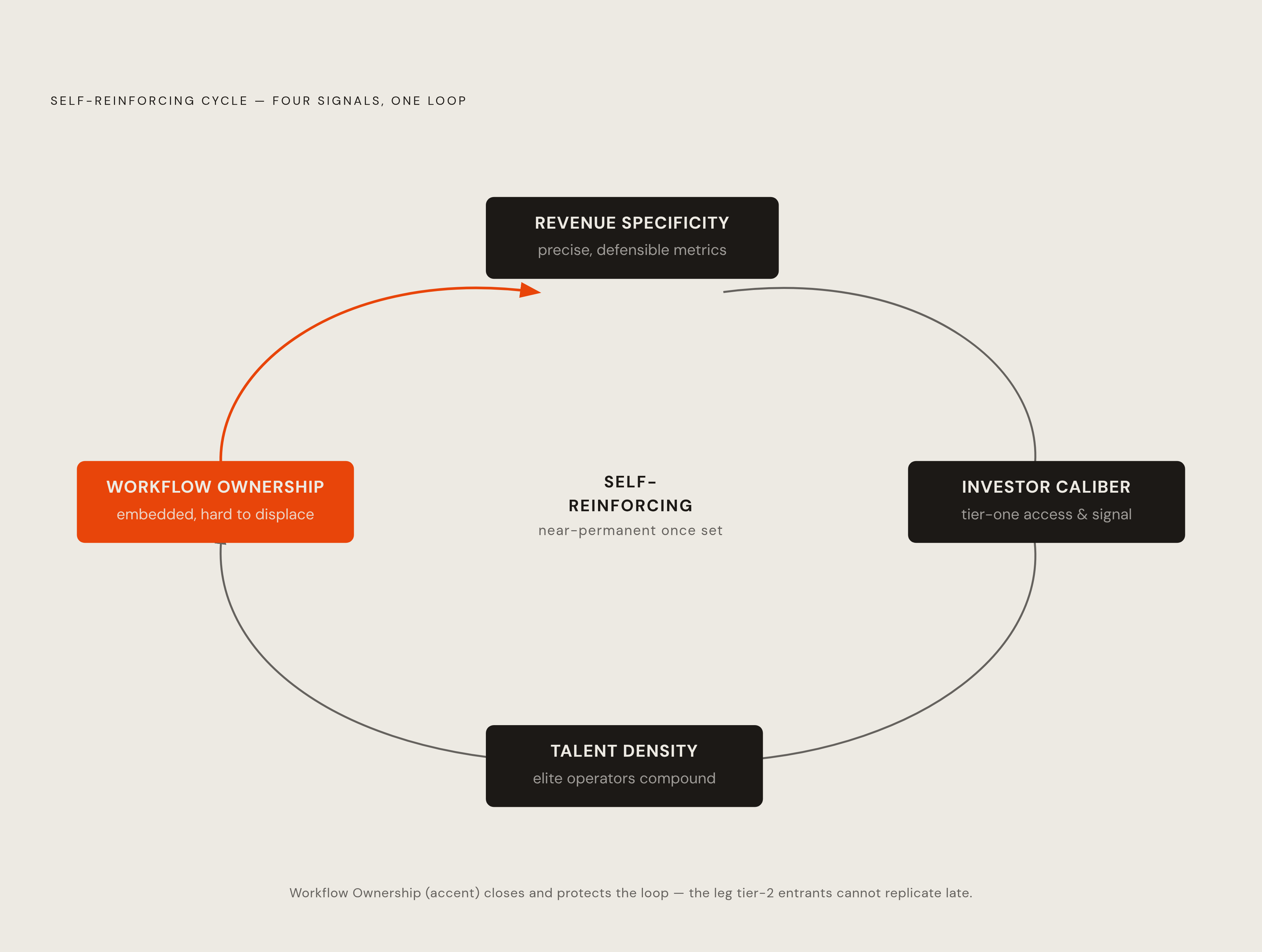
Revenue specificity, investor caliber, founder pedigree, and workflow ownership don't sit next to each other as four separate checkboxes. Each one makes the other three easier to hold onto and harder for a competitor to copy. Specific revenue attracts investors who trust the business model. Those investors make it easier to hire strong engineers. Strong engineers deepen the workflow integration. Deeper integration protects and grows the revenue that started the loop. Each piece feeds the next.
That loop is why tier separation is close to permanent once it sets in. A Tier-2 company that manages to grab one of the four advantages, say, a strong hire or a single good investor, still can't climb on that alone, because the other advantages it's missing aren't available at the terms they were available at when the Tier-1 companies were founded. The price of catching up goes up, not down, the longer the gap exists.
SSI shows this compounding happening at the moment of formation. Sutskever's reputation pulled in institutional capital before there was a product to evaluate. That capital pulled in research talent who wouldn't have joined a less credible outfit. That talent density then creates the technical conditions the investors were betting on in the first place. Each advantage arrived because the others were already in place to produce it. Cognition shows the same loop from the product side instead of the founder side: owning a workflow in AI software engineering pulled in top-tier investors, those investors helped pull in strong engineers, and that talent deepened the technical moat around the product.
What this means for an engineer sizing up two offers: a company that scores well across all four signals early on is not on the same track as a company that scores well on just one or two. The gap between those two companies gets wider over time, not narrower, so the decision carries more weight now than it will look like it does on the day the offer letter arrives.
Applying the framework to a specific startup
None of this requires access to a cap table or an investor deck. Each of the four separators turns into a plain question an engineer can ask in an interview. On revenue, ask what workflow the company owns and how the customer measures the result; a founder who answers with a precise number is in a different position than one who describes a capability in the abstract. On investors, ask who led the round, whether that investor sits on the board, and whether they've committed to following on in future rounds, since a well-known name sitting quietly in a crowded round means something different from a lead investor who stays involved after the check clears. On the founding team, ask what access they bring to the networks the company will need over the next two years: engineering talent, enterprise customers, and follow-on capital, since pedigree matters here as a proxy for access rather than as a stand-in for intelligence or work ethic. On the product itself, ask where it sits inside the customer's daily operation, what breaks if it goes down, and whether the margin structure looks like software or looks like a services business wearing software's clothes.
The hiring process itself reveals a lot too. Tier-1 startups move fast because they know the strongest candidates are juggling several processes at once and will walk away from a slow one; the real benchmark for top AI talent right now is a decision inside ten days. A company that can't make up its mind in that window is either disorganized or unsure about the role it's hiring for, and either one points toward Tier-2. Taken together, these questions let an engineer read a startup's actual structural position rather than its headlines, and that reading is worth more than any funding announcement.