What the Organizational Chart Tells ML Engineers About a Series A Versus Series B Offer
Read org charts to understand whether an ML role builds foundations or owns depth.
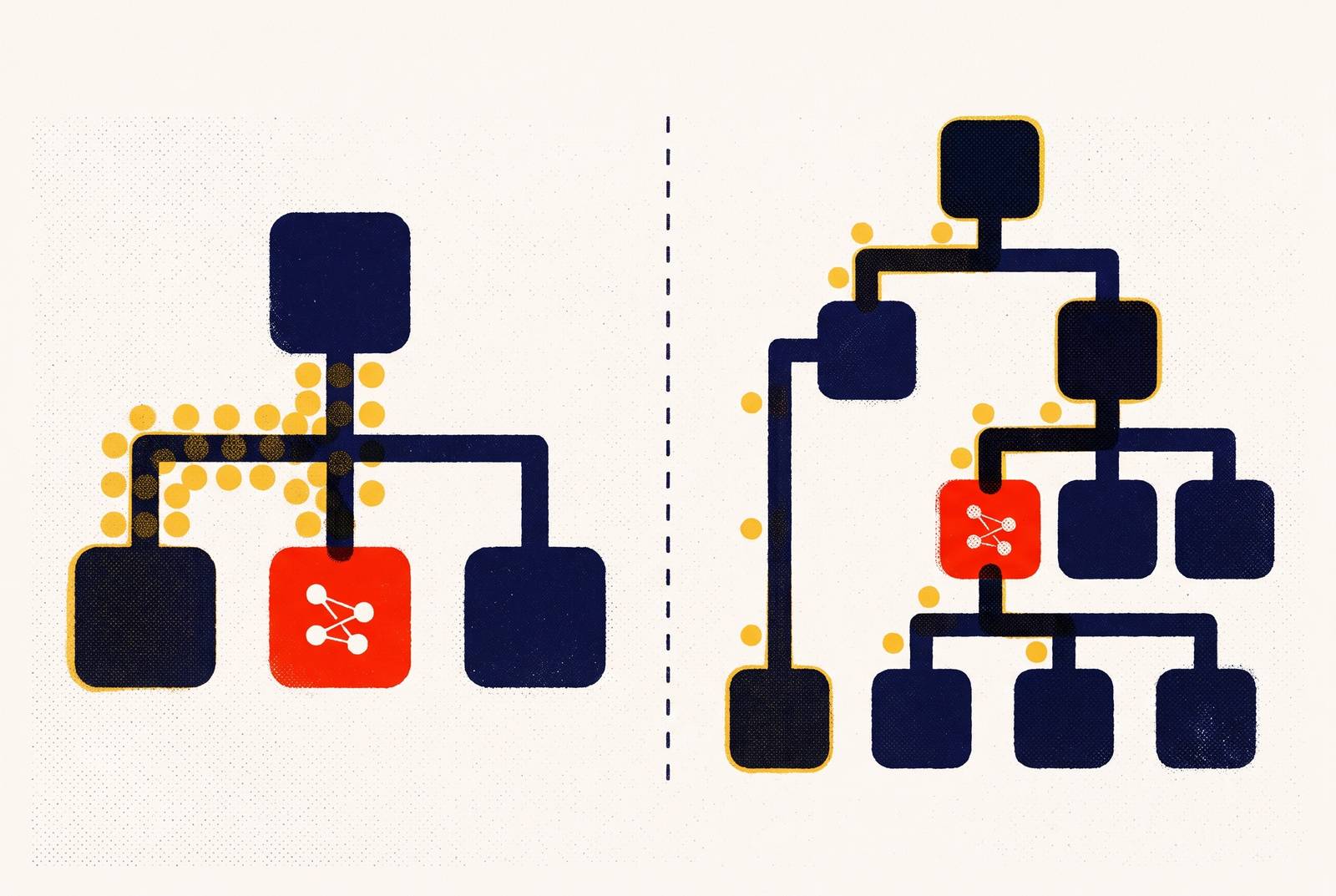
An ML engineering offer at Series A usually means filling gaps in production, while at Series B it more often means taking charge of a defined part of a larger ML organization. The org chart reveals which job is actually on offer. Reporting lines, missing functions, and ownership boundaries give ML engineers a sharper way to compare career opportunities than title and compensation alone.
Why the org chart is a stage-disclosure document, not a reporting diagram
An ML engineer receives two offers, one from a Series A startup and one from a Series B startup. Both say “ML Engineer,” pay roughly the same, and describe building and deploying models. On paper, the jobs look nearly identical. But one chart puts the engineer directly under the CTO with no platform support, while the other places the role inside a product team with shared ML infrastructure.
A job description describes the role the company wishes existed. The org chart describes the organization that actually exists. At Series A, missing owners for deployment, evaluation, and inference cost reveal work that still needs a home. At Series B, managers and shared functions reveal whether the company has begun organizing that work so it can scale. Alongside reporting lines, look for production responsibilities that have nowhere else to go.
The empty space deserves as much attention as the boxes. An applied ML team without a clear handoff to product engineering or infrastructure may lack more than a specialist. It may lack the system that makes the work repeatable, including an evaluation harness, prompt and version discipline, and model cost attribution. A title cannot settle those questions.
What Series A headcount and structure actually look like, and what the gaps mean
A Series A chart may show three to five AI and data people, with founders managing directly and no dedicated MLOps coverage. A typical team includes a data engineer and an ML engineer reporting to the engineering lead or CTO. MLOps may be part-time or absent altogether. This describes a company hiring people to build production capabilities that do not yet have dedicated owners.
Without a data engineer, the ML engineer can inherit the pipeline by default. Without MLOps coverage, deployment and retraining remain part of the same broad job. Missing evaluation ownership raises a different question about how the company judges model quality. These gaps can point to an absent eval harness, no model cost attribution, or a retraining pipeline that is little more than a hurried cron job.
A cluster of researchers with no data or platform counterweight can indicate that the company has hired for model development without covering the work needed to turn it into a product. An engineer joining the team may build on what it can already do or fill the gap that makes everyone else’s work usable.
At this stage, founders managing engineering candidates is normal. But every candidate needing two hours on a founder’s calendar creates a hiring bottleneck.
What Series B structure looks like and why the job changes even when the title does not
At Series B, dedicated engineering managers and clearer reporting lines start to take over from tech leads who arrange the work informally. The company needs more than people who can ship. It needs clear rules on who can decide, priorities that teams know, and documentation that lets them work without executives stepping in all the time. A senior individual contributor may therefore take on mentoring, interviewing, or a cross-functional initiative, even when the title still sounds like a purely technical role.
The hub-and-spoke model makes that change visible. A central hub looks after standards, tooling, and shared infrastructure, and the engineers who work in product teams form the spokes. A spoke engineer works toward specific product goals instead of covering every ML need across the company. Shared infrastructure narrows the work the engineer must build personally. In return, the role operates within standards and ownership boundaries that did not exist on the smaller team.
That structure changes the implicit contract with the hire. The engineer is more likely to own a particular product surface than to decide how the entire ML function should work. Depth replaces some of the earlier breadth. The job may include helping other people work well as well as improving models or writing production code. That is a different kind of engineering impact, even without a management title.
Does AI engineering output grow faster than the cost of coordinating it? Headcount growth without a platform function, a product manager attached to AI, or clear owners for production models suggests otherwise. A company can have twenty ML and platform engineers while its revenue per engineer, deployment reliability, and gross margin get worse.
What should an ML engineer look for in a Series A versus Series B role?
“ML Engineer” is a dialect. The title can describe a generalist who builds data pipelines, engineers features, trains models, and puts them into production. It can also describe a research-leaning engineer with a strong theoretical background, especially valuable when the core product is a foundational AI capability. A third profile focuses on training pipelines, experiment tracking, model serving, and feature stores. That platform role is closer to SRE with ML context than to research.
The wider title landscape has similar overlaps. An AI engineer turns existing models into a useful product, while an ML engineer makes ML systems reliable and scalable. A research scientist creates or validates new methods. For most Series A and B startups building on foundation models, the generalist comes first because the company needs the whole path from data to production to work.
That need explains a common hiring mismatch. A research-leaning engineer can be harder to hire and command higher compensation, yet still be the wrong first hire when evaluation, observability, and data loops are unstable. The chart shows whether the surrounding team can support that specialization or whether the engineer will have to leave it behind to cover basic production needs.
The reporting context makes the distinction concrete. At Series A, an ML engineer reporting to the CTO with no data engineer nearby is a generalist, whatever the job description emphasizes. At Series B, the same title under a Director of AI, inside a spoke with dedicated MLOps and an AI product manager, points toward domain ownership. One role covers the stack by necessity. The other goes deep on a defined surface because supporting functions already have owners.
What "Founding ML Engineer" at Series A signals that a Series B title does not
“Founding ML Engineer” means building the function. When there is no evaluation harness, MLOps coverage, or data engineer, the founding hire becomes accountable for all three by default. The missing organization becomes part of the job. Unlike a specialist joining an established team, this engineer must work out both what needs building and how the company will own it.
In 2026, that scope spans infrastructure, product code, and data modeling. Building agentic workflows and RAG architectures is a core requirement. Technical breadth alone is not enough, though. The role also requires the agency to make decisions and ship without a settled specification. An ambiguity test, built around an open product requirement, probes that ability more directly than LeetCode does.
Timing changes how much of the function remains open. A company searching for its founding ML engineer two months after Series A offers a different opportunity from the same company nine months after the round. The founding window closes as the team takes shape. The label is therefore most useful when read against existing headcount and ownership, rather than treated as a promise of influence on its own.
There is no structural Series B equivalent to founding the ML function from nothing when that function already has a lead, a shape, and existing staff. A new hire in that organization owns a domain. The trade-off remains open. Founding ML engineering at Series A offers the highest leverage and ambiguity, while Series B domain ownership brings lower ambiguity, clearer scope, and a different kind of impact.
How to read compensation and equity as stage-disclosure data, not just offer numbers
The balance between salary and equity reflects how much risk the company transfers to the engineer and how much upside remains available. Series B salaries tend to be closer to market rate than Series A salaries, with smaller equity grants and less risk from how the company is set up. The grant belongs to an offer for a particular role inside a particular organization.
Leaner teams can mean larger individual grants because fewer early engineers share the equity pool. As AI tooling compresses team size, a grant can reflect both the small number of people doing the work and the funding round. That links the offer back to the chart. A broad role on a sparse team and a narrow role on a staffed team need not produce the same equity package.
The cap table shows more than the org chart alone can show. An AI founding team at Series B holds a meaningfully larger ownership share than a non-AI founding team, which compresses the pool available to new hires. A small team therefore does not, by itself, establish how much equity is available. The two documents answer different questions.
Contradictions between the offer and the chart are especially useful. A Series B package with a large grant and low base carries risk much like Series A, but the chart may show no function still at an early enough stage to explain those terms. The company may be misrepresenting its stage or mispositioning the role. A company that can state a percentage but cannot explain concretely what the equity is worth is revealing a limit in its operational maturity.
How the hiring process itself mirrors the org chart's stage signal
Who can approve a hire, who defines the technical bar, and who keeps the process moving are visible before the offer arrives. At Series A, founder involvement fits the structure. At Series B, hiring managers should make the decisions through a process with clear steps. A loop that still needs CEO sign-off on every engineering candidate contradicts the management layer shown on the chart.
A senior ML hiring loop should have three rounds at most, covering a hiring manager or recruiter screen, a technical evaluation, and a team loop. The technical evaluation can be a take-home or an ML design session. Four or more rounds signal disorganization. The substance should also match the job, using a production system to probe data, deployment, observability, and cost. Algorithm puzzles for a founding ML search test for the wrong role.
A company nine months past Series B can be a different, slower employer than the same company two months after the round. A fast, well-structured process suggests defined decision rights, a hiring manager with authority, and a role that is a genuine priority. Those are claims the chart makes on paper. The hiring loop either supports or contradicts them.
The org chart and hiring process are the same document at different resolutions. Reading both turns an offer comparison into an assessment of the company’s current operating reality, including the work already owned and the work waiting for the person who accepts.