The Founding Team Dilution Conversation Big Tech ML Engineers Never Think to Have
Judge a founding-engineer offer by what remains after dilution.

For ML engineers evaluating career opportunities at Series A and Series B AI startups, the equity percentage is a starting point. A founding-engineer offer needs to be judged against future dilution, cash and RSUs forgone, and the role’s actual scope.
Why Big Tech ML engineers misread founding-engineer equity before they sign
An engineer can know model architecture, training pipelines, and evaluation loops in depth without knowing who pays when an investor asks for a larger option pool. These are different kinds of expertise. Big Tech compensation builds familiarity with RSUs, vesting schedules, and a liquid stock price. It may not teach engineers how to track their share of a private company as its share count grows.
The engineer negotiates a headline equity number, anchors on it, and treats later fundraising mainly as evidence that the company is succeeding. But a successful round can also reduce ownership. Without a view of the future cap table, the engineer has negotiated an opening stake without understanding what might remain at exit, if an exit happens at all.
What the grant actually says versus what it means on a live cap table
A founding-engineer grant usually specifies a fixed number of shares or options. The percentage depends on a separate number. Fully diluted capitalization counts the shares that exist and those that could come from instruments such as options and the employee pool. As that denominator grows, a fixed grant represents less of the company. The offer therefore needs both the grant count and its percentage of fully diluted capitalization at the time of grant.
For options, the strike price is the price paid to buy each share. Pre-money means before the new investment, while post-money means after it. Those terms establish when a valuation or capitalization is being measured, which becomes crucial when the company expands its option pool around a financing. A percentage without that timing is incomplete. The useful comparison is the cap table today against the cap table after the next anticipated round.
The “founding engineer” label does not fix the grant size either. The median grant falls from 1.50% for hire #1 to 0.85% for hire #2, a 43% cut between hiring positions.
The option pool shuffle and who pays for it
When a new investor closes a round, they typically require the company to expand its employee option pool before closing. That timing determines who absorbs the dilution. With a pre-money expansion, existing holders bear the pool increase before the investor buys in. The investor gets the benefit of a pool set aside for hiring without taking any of the dilution from creating it.
The before-and-after picture is simple enough to follow. Before the pool grows, the engineer’s grant is measured against the fully diluted share count at that time. Afterward, the grant is unchanged, but the pool has enlarged the denominator. The new investment then adds another reduction in ownership. An engineer who joined before seed is already an existing holder when the Series A investor requests this top-up.
A post-money expansion works differently because all post-closing holders, including the new investor, share its dilution proportionally. Pool size also changes the outcome. Trimming a seed option pool from 10% to 5% can preserve roughly 5 percentage points for founders and early employees. Yet the offer letter does not disclose the terms of a future financing. An engineer negotiating 1.5% at pre-seed may see that stake reduced before Series A closes through a pool expansion they were never consulted on.
How round-by-round dilution compounds, with real numbers from a typical trajectory
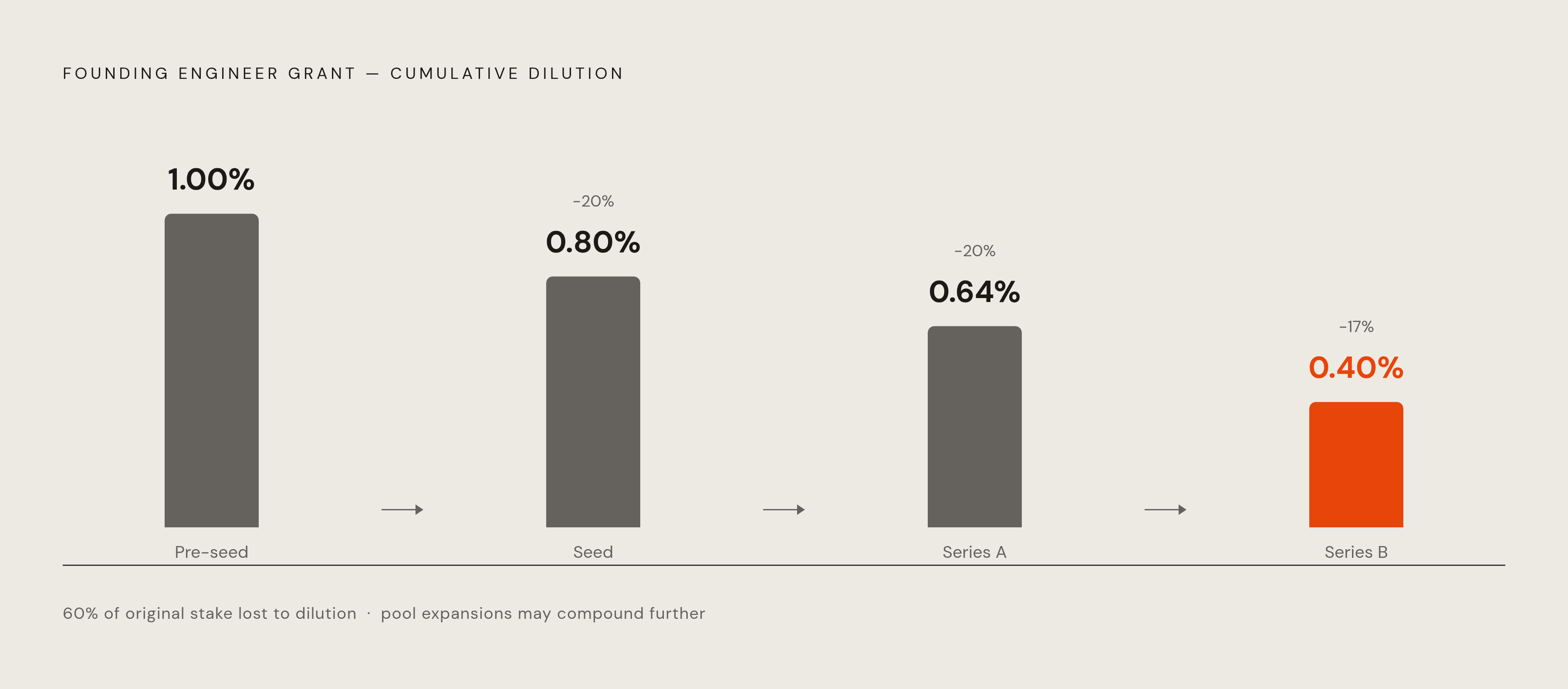
Each funding round cuts the ownership left after the round before it. Typical dilution runs roughly 20% at Seed, 20% at Series A, 17% at Series B, 10% at Series C, and 7.5% at Series D. Pool expansions can add further reductions, so investor ownership alone does not describe the whole path.
A 1% pre-seed grant can end up at approximately 0.4% post-Series B. That scenario includes dilution beyond the round percentages above. The distinction prevents false precision. To understand a particular offer, the engineer needs the company’s expected pool changes and financing assumptions.
There is also a condition hidden inside that trajectory. Only a minority of pre-seed startups reach Series B. The engineer gives up compensation while that outcome remains uncertain. A base salary $60K–$80K below Big Tech for four years makes the starting stake a costly bet, even before asking whether the stake left at the end will ever become liquid.
What down rounds add on top and the double squeeze
A down round prices the company below its previous financing and can introduce another source of dilution. Preferred shareholders may have anti-dilution protection that adjusts their equity to reflect the lower price, further diluting common holders, including option-holders. A pre-money pool top-up at the same time adds to that loss. The engineer is squeezed by both the preferred-stock adjustment and the expanded hiring pool, without equivalent protection for their own common stock options.
Full-ratchet anti-dilution reprices every existing preferred share to the new lower price regardless of how many shares the new round issues. Broad-based weighted average protection blends the old and new prices using the fully diluted capitalization, so the adjustment is far smaller. The latter is the market standard in the overwhelming majority of U.S. venture financings. Engineers should still ask rather than assume, because the difference determines how hard a down round hits their stake.
The cash penalty that makes the dilution math worse than it looks
The shrinking percentage is only half of the bargain. The engineer also pays through lower compensation. Pave’s founding-engineer benchmarks put senior base pay at the 50th percentile near $187K. That is below the $236,875 median base for a senior AI/ML engineer at a Tier-1 company. Base-to-base comparisons are useful, but they do not capture the full cost of leaving a package with liquid equity.
An engineer who gives up $60K–$80K a year for four years gives up $240K–$320K in compensation. Economically, that resembles writing a check to invest in the startup at its most uncertain stage. Would the engineer choose to put that amount of cash into this company on these ownership terms?
Unvested RSUs at Google, Meta, or Microsoft add a specific cost to the decision. They are a stream of value tied to liquid stock that the engineer can receive in the near term, but only by staying long enough for them to vest. Leaving interrupts that stream. Its dollar value and vesting timeline belong in the comparison, rather than being waved away by a private-company equity projection that may never turn into cash.
The co-founder equity split and role taxonomy confusion that compound the problem
Some startups make the exceptional offer of addressing the gap by making technical hires co-founders and granting 10%–15%. Engineers should discuss that distinction when the company expects them to work as a partner. Engineers should ask whether co-founder status or economics are possible and what would qualify them. If the founders say no, that also helps show how much say they plan to share in the company’s direction.
An AI Engineer builds product features on models that already exist, an ML Engineer builds and runs production ML systems, and a Research Engineer builds new model capability from scratch. Most Series A/B AI startups need an ML Engineer or Research Engineer. Yet “founding engineer” can obscure these differences in scope and leverage. An engineer hired under the wrong expectations can underperform, lose influence, and see the equity-for-impact bargain unravel before the first cliff, even without a change to the cap table.
The specific questions to ask before signing, in the order they matter
The conversation should begin by establishing what is being offered. “What percentage of fully diluted shares outstanding does this grant represent, and what is the total fully diluted share count?” Then ask for the documents behind that answer. “Can you share the most recent 409A valuation, my strike price, and the capitalization table as it stands today?” A refusal leaves the engineer without the information needed to price the bargain.
Next, move from the current denominator to its likely growth. “How large is the current option pool, what expansion is anticipated at the next round, and would that happen pre-money or post-money?” Follow with the financing path. “How many rounds do you expect to raise, what approximate ownership percentages would new investors receive, and what would that imply for my stake at a Series B exit?” These plans may not come true, but they show how the headline offer could change.
“Does the charter give preferred shareholders full-ratchet or broad-based weighted average anti-dilution protection?” Then bring the compensation sacrifice into the discussion. After quantifying unvested Big Tech equity by value and time to vest, ask, “Can you make me whole for the RSUs I would leave behind, or account for them in the equity grant?” This is a standard negotiation ask.
“Given the scope of this role, is a co-founder title or co-founder economics possible, and if not, why?” The answer helps calibrate the influence attached to the job. Then ask, “Does the option plan allow early exercise?” Buying shares immediately upon grant can start the capital gains clock earlier and materially change the tax outcome at exit, so the plan’s terms belong in the decision before signing.
How to evaluate an ML engineering offer from an early-stage AI startup
Once those answers are available, the comparison is startup equity against four more years of liquid, vesting Big Tech RSUs, plus the cash compensation difference. A useful stress test takes a 1% pre-seed grant through two more rounds to near 0.6%, distinct from the longer path to approximately 0.4% post-Series B. Even then, beating four years of Big Tech compensation at current AI/ML rates requires a tail outcome: an exit well into nine figures.
The founding-engineer bet has an approximately 6–8% joint probability of paying off as designed. Negotiating a larger percentage does not make an exit more likely. The role can under-compensate for its risk even when the initial grant looks generous, because the employee pays through forgone earnings while the payoff remains conditional.
For a Series A versus Series B opportunity, stage helps frame the trade but does not decide it. Earlier-stage roles tend to offer less cash and a larger share of the company, with a greater risk that the equity ends up worth nothing. Later-stage roles generally offer more cash, a smaller percentage, and narrower but more reliable upside. Neither is universally better. The meaningful comparison uses the actual role, remaining fundraising needs, pool plans, strike price, and compensation sacrifice.
The attractive cases have more than an ambitious equity story. They have research depth the company would struggle to replace, a founding team with a track record, a valuation low enough to leave room for a worthwhile gain after dilution, and a cap table they share in full. Engineers who get referrals to vetted AI startups may know more about the quality of the investors, the runway, and the founding team from the start than those who apply cold. Those signals inform the bet alongside the ownership questions. The offer is worth considering when the surviving stake and the work justify the price being paid for them.