Best SF Neighborhoods and Offices for AI Startup Energy in 2026
Where SF's AI talent and capital cluster matters more than which company you join.
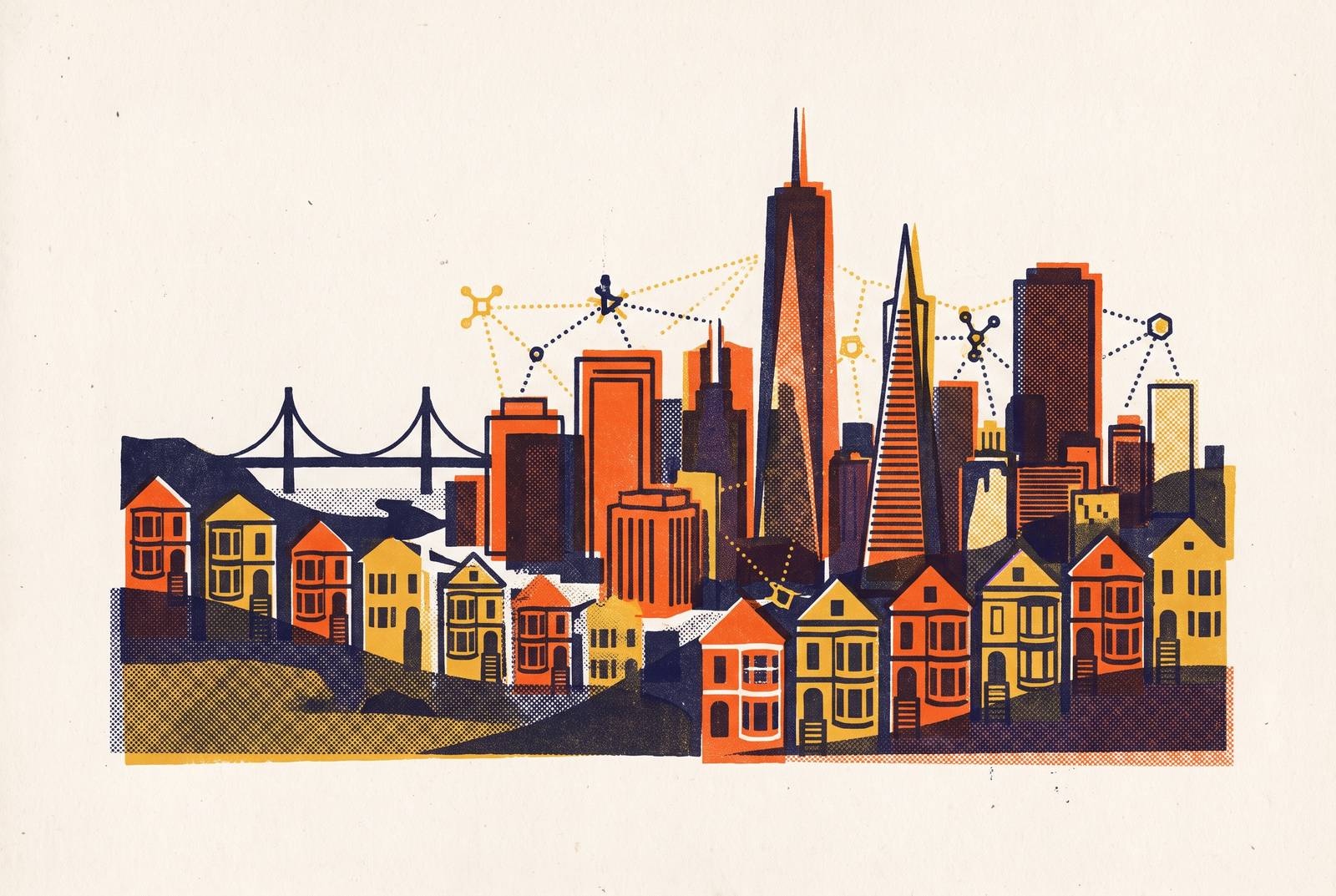
San Francisco's AI boom pools in a handful of corridors, each with its own gravity, its own tenants, and its own use to an engineer deciding where to plant a flag.
Why SF's AI energy is geographically concentrated, not city-wide
San Francisco has re-identified itself as the core brain trust of global AI. But that status lives in specific blocks and buildings, not the city as a whole. Capital, frontier talent, and compute access tend to cluster together, and once they do, being near the cluster becomes worth more than being near any single company inside it. A founder picks an office two blocks from a competitor instead of a cheaper spot across town because proximity to the cluster is worth more than cost savings. The count of AI companies holding SF office space has grown fast, and the square footage they occupy now makes up a real share of the city's total office supply.
Remote work hasn't undone this. If anything, AI companies have pulled back from remote-first harder than almost any other part of tech. Model development and infrastructure scaling run on fast, messy iteration loops, and those loops work better when the people running them sit in the same room. That's a structural reason to care about geography again, not a nostalgia play.
For an engineer, the map that follows isn't trivia. Knowing which corridor holds which kind of company, at which stage, is a career decision disguised as a real estate fact.
Mission Bay: the largest gravity well
Mission Bay is where the AI wave's dominant player physically lives. Its vacancy rate is near zero, reflecting density that has already peaked. OpenAI built its campus in stages: it first subleased half of Uber's Mission Bay headquarters at 1455 and 1515 Third St., then took the entire building, and has since subleased Dropbox's former offices in the same neighborhood.
OpenAI's total SF footprint now compares to Facebook's physical presence at its 2018 peak. It has passed Salesforce to become the city's second-largest office tenant, trailing only Google.
For engineers, Mission Bay works like a campus, not a scene. Nobody wanders into ambient AI culture here the way they might in a neighborhood built around meetups and coffee shops. The value of being in Mission Bay is proximity to the biggest single employer in the AI industry and to the alumni network that radiates out from it. That tightness has consequences beyond Mission Bay's own borders: with vacancy near zero, brokers are now pushing companies toward Design District/Showplace Square and into SoMa, where highway access is just as good and rents cost meaningfully less. That's how the next corridor got built.
SoMa's Howard Street corridor and the emergence of "AI Alley"
SoMa absorbed the overflow from Mission Bay and turned it into a cluster with its own identity. Anthropic anchors it. The company's SoMa footprint started with a large block subleased from Slack at 500 Howard St., then grew into neighboring buildings, with plans to occupy an empty building at 300 Howard St. New owners along the corridor have started marketing it as "AI Alley," and the companies filling it in back that name up.
Harvey AI leased two more floors at 201 Third Street, adding to an already large footprint, after raising a round that valued the company in the multi-billion-dollar range. Sierra AI, led by Bret Taylor, signed one of the city's largest single office deals at 185 Berry St. in China Basin, following hundreds of millions in funding and a $350 million round that pushed its valuation to a serious premium. Together AI took a large block at 2 Henry Adams St. Fal signed space at 300 Mission.
What makes SoMa and China Basin different from Mission Bay is variety. Engineers here can walk between infrastructure companies and application-layer companies in minutes, at every stage from early growth to late-stage scale-up. That walkable mix is where the informal cross-pollination of ideas, hires, and gossip actually happens, and it's a different kind of value than what Mission Bay offers.
Hayes Valley ("Cerebral Valley") as the grassroots counterweight
Hayes Valley runs on a different logic than Mission Bay or SoMa. The biggest leases aren't signed here. The earliest-stage energy is. Hayes Valley has become the epicenter of what's known as "Cerebral Valley," packed with hacker houses and early-stage YC startups, with a social life built around AI meetups and technical salons.
That makes Hayes Valley useful for a different reason than Mission Bay. It's where engineers meet the people building things at pre-seed and seed, often before those companies have signed a lease anywhere. The next wave of founding engineer roles tends to start here, in conversation, before it appears as a job posting. Y Combinator has backed over 840 AI startups in the Bay Area, and that alumni network runs through Hayes Valley's informal scene constantly.
Some of this can feel closed off if you're not already inside the YC orbit. The hacker house culture has its own shorthand and its own social graph, and that can read as exclusionary from the outside. But the meetups and salons are mostly open to anyone who shows up. Attendance is the barrier. For engineers weighing where to live against where to work, Hayes Valley is the clearest answer to one specific question: where do you meet founders before they're hiring on LinkedIn.
Dogpatch and the Pier 70 corridor as the next expansion front
Dogpatch is where the physical infrastructure behind the AI boom is being built, making it the most forward-looking neighborhood for an engineer thinking two or three years out. Y Combinator moved its campus to Pier 70 on the southern waterfront in 2023, and Garry Tan runs its operations from there, giving Dogpatch a direct institutional anchor for the startup pipeline.
The 29-acre Dogpatch Power Station project is being revised to add flexible R&D space, a response to demand from AI companies that need bigger floor plates and more power capacity than a typical office conversion can supply. Thinking Machines Lab, led by Mira Murati, leased a building at 2300 Harrison St. in the adjacent Mission district, part of the same eastward push.
None of this is finished business. The Power Station project reflects demand, not a signed outcome, and the shape of Dogpatch's build-out is still taking form. What's clear already is the direction: this is where compute and R&D infrastructure are landing physically, which matters more for infrastructure and research roles than for application-layer work.
Jackson Square and Potrero Hill: smaller-scale signals worth reading
Jackson Square and Potrero Hill tell two smaller, related stories. One is about where AI's founding generation started before it outgrew its first home. The other is about what AI money does to the neighborhoods sitting next to the big clusters.
Jackson Square has one of the tightest vacancy rates in San Francisco and commands rents to match, driven by AI startups and venture capital firms competing for the same small supply of space. Anthropic began here in 2021, in a small office. OpenAI picked up a presence in the neighborhood when it acquired one of Jony Ive's companies. Both have since moved on, Anthropic to SoMa, and that move says something about Jackson Square's ceiling: its boutique scale can host a company at birth but not at growth. Today Jackson Square functions mainly as a VC and early-stage zone. It's a good place to meet investors, not a strong place to find a founding engineer role at scale.
Potrero Hill shows the other side of the same story. Its residential market has run up noticeably since OpenAI set up its Mission Bay campus nearby, with homes selling well above asking price. That's a concrete, visible example of how AI employment geography turns into housing cost pressure for anyone weighing a move into the area.
What the office design shift tells engineers about serious companies
The physical requirements of serious AI companies, high power capacity, large floor plates, space that can be converted for R&D, appear directly in the real estate market, and they work as a decent proxy for how technically ambitious a company is. Landlords and developers across Dogpatch, the Design District, and SoMa are underwriting those needs directly: heavier power capacity for compute-heavy workloads, and open floor plates for model development teams running collaborative experiments.
The shift from subleasing to direct, longer-term commitments in Class A buildings, which Savills and CompStak documented for the first half of 2026, shows companies signing multi-year build-outs instead of hedging on whether SF's AI moment holds, a much bigger bet than a two-year sublease.
That said, a big lease doesn't always mean a big headcount. Plenty of AI companies valued at billions of dollars in 2026 employ fewer than 200 people, because the value sits in the models and the infrastructure access, not in headcount. A massive office doesn't necessarily mean a massive team. It might mean a small, very well-paid group working in a lot of square footage.
That gives engineers a usable read. A company leasing a converted warehouse in the Design District or Dogpatch, with upgraded power and big open floors, is signaling R&D intent. A company subleasing polished Class A space in SoMa is more likely signaling go-to-market and growth-stage ambition. Neither one is better. They just attract different kinds of engineers.
Using the neighborhood map when making a move
None of this matters unless it changes how an engineer positions themselves to be found. The neighborhood someone is embedded in signals which stage and which type of company they're close to, and that signal reaches recruiters and founders whether or not anyone says it out loud.
The strongest channel for landing a founding engineer role at an AI startup is still a founder's own prior work network. Showing up physically in the right community, a YC salon in Hayes Valley, the alumni circle around a Dogpatch R&D tenant, is how that channel opens up to people who weren't already inside it.
Founding engineer hiring in San Francisco is tighter now than at any point since 2021. AI-native companies at the seed-to-growth stage are competing directly with frontier labs for engineers who can show verifiable zero-to-one shipping work, and the strongest candidates don't stay on the market long. Most of them are holding multiple active offers by the time they're deciding. Speed is the real constraint here: good engineers leave open hiring processes fast, so being in the right geography and the right community shortens the window where both sides can actually find each other.
Being in the right zip code lowers friction. It doesn't replace having visible work. The engineers landing founding roles in the Mission Bay and SoMa clusters are the ones with a public GitHub, a presence at the right conferences, or a track record at a prior startup, not the ones who simply moved closer to the action.